Why Do People at the Back of a Concert Hear the Same Performance as Those Standing in Front?
Imagine attending a concert with thousands of people. The audience standing just a few metres from the stage hears every lyric clearly. Surprisingly, someone sitting 80 or even 100 metres away can often hear the same performance with remarkable clarity and balanced volume. Meanwhile, people seated at the far left and right sides of the venue still enjoy consistent sound without overwhelming echoes or painful loudness.
This isn’t simply because the speakers are louder.
In fact, making speakers louder would often create the opposite problem—uneven coverage, excessive reflections, distorted audio, and uncomfortable listening levels for those closest to the stage. The real solution lies in physics.
Modern event productions rely on line array speaker systems, one of the most significant innovations in professional audio engineering. Unlike conventional loudspeakers that spread sound broadly in all directions, line arrays are designed to precisely control how sound travels through a venue. By manipulating sound dispersion, wave interference, speaker angles, and acoustic coverage, engineers can deliver consistent audio quality across audiences of hundreds—or even tens of thousands—of people.
Whether it’s a corporate conference, music festival, product launch, government ceremony, exhibition, or hybrid event, understanding how line arrays work explains why professional sound systems are far more than simply stacking bigger speakers. Every speaker cabinet, every angle, and every measurement is carefully calculated to ensure every seat experiences clear, intelligible, and immersive sound.
In this guide, we’ll explore the fascinating physics behind line array technology, why controlling sound dispersion matters, how engineers design systems for different venues, and why investing in professional audio engineering makes all the difference to an event’s success.
What Is a Line Array Speaker System?
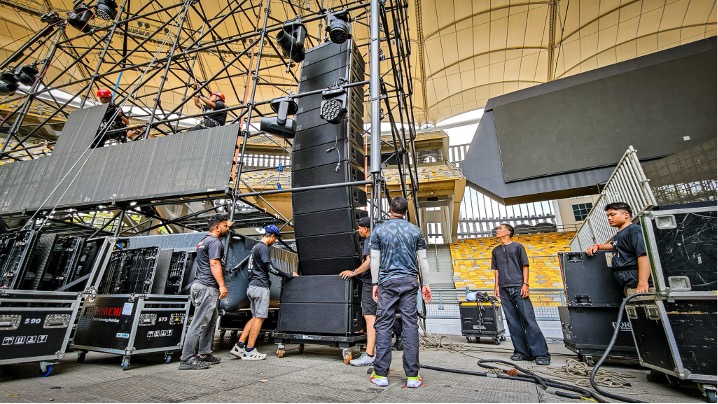
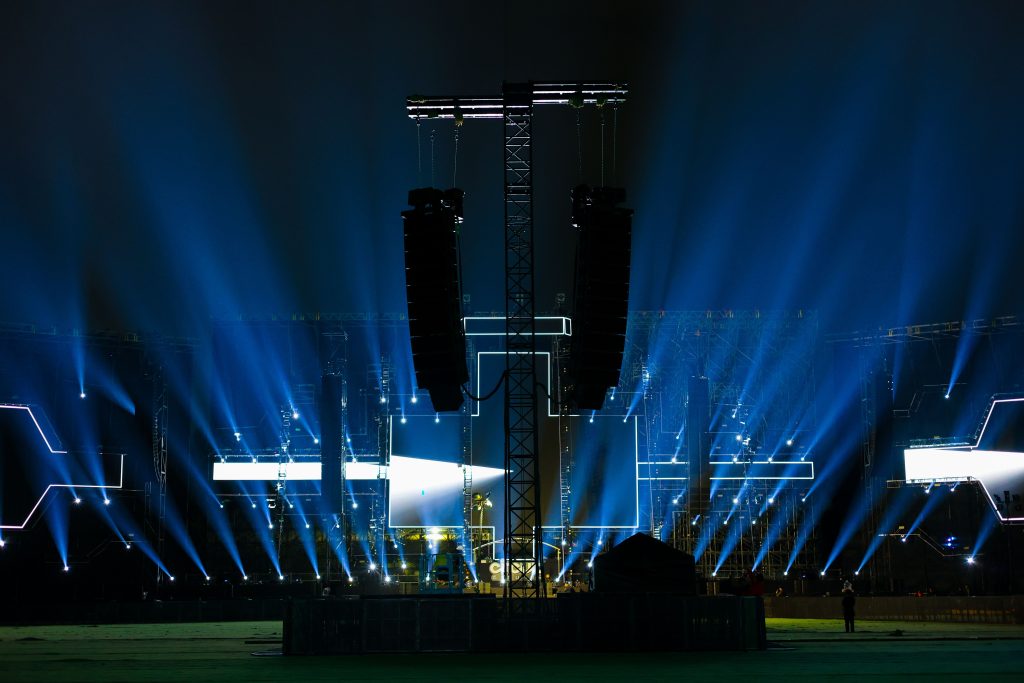
A line array is a series of identical loudspeaker cabinets that are vertically suspended and arranged in a curved configuration. Rather than relying on one large speaker to project sound, multiple speakers work together as a single acoustic system.
This design allows sound engineers to control how audio spreads horizontally and vertically, ensuring even sound coverage across an audience.
You’ll commonly find line arrays at:
- Large concerts
- Corporate conferences
- Product launches
- Stadium events
- Outdoor festivals
- Houses of worship
- Government ceremonies
- Exhibition halls
- Hybrid and live-streamed events
Today, line arrays have become the industry standard for medium to large-scale events because they deliver greater consistency, improved speech intelligibility, and more efficient sound distribution than traditional point-source speaker systems.
The Science Behind Sound Dispersion
To understand why line arrays work so effectively, it helps to understand a simple fact about sound.
Sound travels as waves.
Just like ripples spreading across water, sound waves move outward from a speaker in every direction unless controlled. A conventional speaker naturally disperses sound in a wide cone. As the sound travels farther:
- Volume decreases.
- Reflections increase.
- Clarity is reduced.
- Different frequencies behave differently.
This is why simply increasing speaker volume doesn’t guarantee better sound. Professional audio engineering focuses on controlling where the sound travels—not just how loud it is.
Understanding Sound Dispersion
Sound dispersion refers to the way sound spreads after leaving a loudspeaker. There are two primary directions:
Horizontal Dispersion
This determines how wide the sound spreads from left to right. A wider horizontal coverage allows audiences across the venue to hear clearly without needing excessive speaker volume.
Vertical Dispersion
Vertical dispersion controls how much sound travels upward and downward. This is especially important because unnecessary vertical sound creates reflections from:
- Ceilings
- Floors
- Walls
- Glass surfaces
Reducing unwanted vertical dispersion significantly improves speech clarity.
This is one of the biggest advantages of line arrays.
Why Traditional Speaker Stacks Have Limitations
Before line arrays became common, many events relied on large speaker stacks positioned on either side of the stage.
Although effective for smaller venues, these systems presented several challenges:
- Front rows received excessive volume.
- Rear audiences struggled to hear.
- Sound reflected heavily from ceilings.
- Echoes became more noticeable.
- Speech intelligibility suffered.
- Coverage was inconsistent.
As venues became larger and productions more demanding, engineers needed a smarter solution.
How Line Arrays Control Sound
Instead of one speaker projecting sound independently, line arrays combine multiple loudspeaker cabinets that interact acoustically. Each cabinet produces sound that overlaps with the next. Through careful spacing and precise angling, these sound waves reinforce one another in desired directions while minimizing unwanted dispersion. This phenomenon is known as constructive and destructive interference.
When engineered correctly:
- Useful sound combines.
- Unwanted sound cancels.
- Coverage becomes smoother.
- Audio remains balanced throughout the venue.
Rather than fighting physics, line arrays use it to their advantage.
The Importance of Curvature
If you’ve looked closely at a concert line array, you may notice that the speakers are not perfectly straight. Instead, they form a carefully calculated curve. This curvature allows engineers to direct sound toward different audience areas.
For example:
Upper speakers project farther into the venue. Lower speakers cover audiences closest to the stage.
This prevents excessive overlap while ensuring every seating section receives consistent sound. Modern prediction software calculates these angles long before installation begins.
Why High Frequencies Behave Differently
Not all sound frequencies travel the same way.
High-frequency sounds:
- Are more directional.
- Lose energy faster.
- Are easily blocked.
- Reflect strongly from hard surfaces.
Low-frequency sounds:
- Spread in almost every direction.
- Travel farther.
- Penetrate obstacles more easily.
- Are much harder to control.
Professional line array systems therefore combine different technologies to manage each frequency range effectively.
Low Frequencies Need Subwoofers
Line arrays primarily reproduce mid and high frequencies. Deep bass is usually handled by dedicated subwoofers.
Subwoofers provide:
- Impact
- Warmth
- Musical energy
- Low-frequency extension
Engineers carefully position subwoofers because bass behaves very differently from higher frequencies. Incorrect placement can produce uneven bass where one audience section experiences overwhelming low frequencies while another hears very little.
Beam Steering: Directing Sound Like Light
Modern line array systems often incorporate advanced processing techniques known as beam steering. Beam steering electronically adjusts timing and phase between speakers. This allows engineers to “aim” sound without physically moving every cabinet.
Benefits include:
- Better speech clarity
- Reduced echoes
- Improved coverage
- Less sound directed toward reflective surfaces
Beam steering is particularly valuable in:
- Auditoriums
- Conference halls
- Houses of worship
- Airports
- Convention centres
Digital Signal Processing Makes It Possible
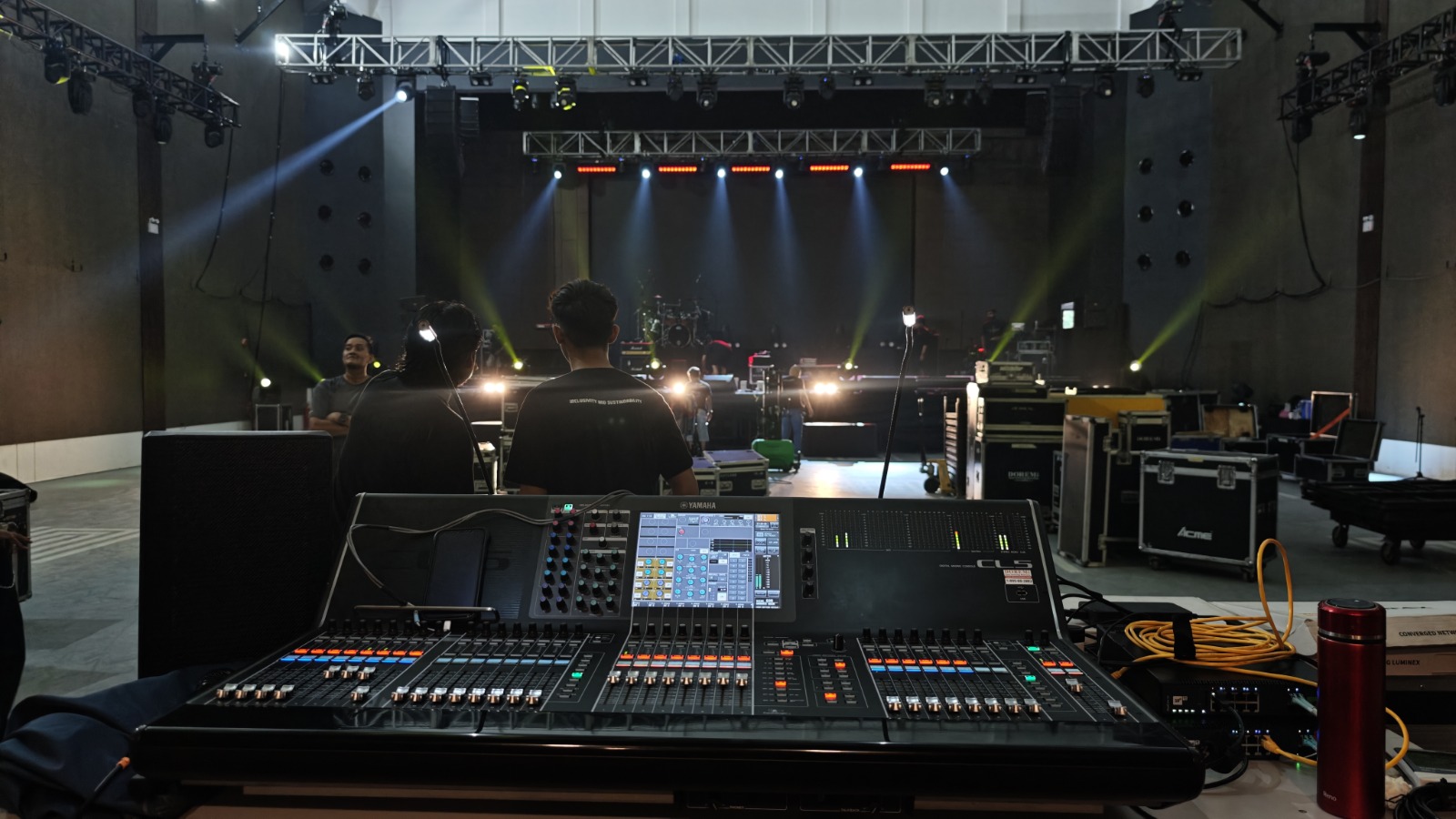
Today’s professional audio systems rely heavily on Digital Signal Processing (DSP).
DSP continuously adjusts:
- Delay
- Equalisation (EQ)
- Frequency response
- Phase alignment
- Crossovers
- Limiting
- Protection settings
Rather than relying solely on speaker hardware, DSP optimises system performance for each venue.
Every Venue Requires Different Calculations
One of the biggest misconceptions is that professional speakers can simply be reused without adjustment.
Every venue presents unique acoustic challenges.
Engineers evaluate:
Venue Dimensions
Length, width and ceiling height influence sound propagation.
Audience Size
A venue filled with people absorbs much more sound than an empty hall.
This changes overall system tuning.
Building Materials
Concrete, glass and steel reflect sound differently than curtains, carpets or wood.
Ceiling Height
Tall ceilings increase reflections.
Proper vertical dispersion becomes even more important.
Outdoor Conditions
Open-air events eliminate wall reflections but introduce:
- Wind
- Temperature changes
- Humidity
- Environmental noise
Each factor affects sound propagation.
Why Audio Simulation Software Matters
Professional event companies don’t rely on guesswork.
Before equipment even arrives onsite, engineers often use advanced acoustic prediction software.
Simulation tools allow them to model:
- Speaker placement
- Audience coverage
- SPL (Sound Pressure Level)
- Frequency response
- Delay timing
- Coverage consistency
This helps minimise surprises during installation and significantly improves setup efficiency.
Common Mistakes That Affect Sound Quality
Even high-end equipment cannot compensate for poor system design.
Some common mistakes include:
Hanging Speakers Too High
This causes sound to overshoot audiences.
Incorrect Speaker Angles
Poor angling creates gaps in coverage.
Too Few Speakers
Trying to cover a large audience with insufficient speakers results in inconsistent sound levels.
Excessive Volume
Increasing volume rarely solves poor coverage and often creates distortion.
Ignoring Room Acoustics
Hard reflective surfaces require different system tuning than carpeted venues.
Why Line Arrays Are Ideal for Corporate Events
Many people associate line arrays with concerts, but they are equally valuable for corporate productions.
Clear communication is essential during:
- Business conferences
- Product launches
- Award ceremonies
- Annual general meetings
- Government functions
- Investor presentations
- Hybrid events
A professionally designed line array system ensures speeches remain intelligible throughout the venue while maintaining comfortable listening levels.
When every word matters, proper sound dispersion becomes just as important as visual presentation.
Emerging Trends in Line Array Technology
Professional audio continues to evolve with advancements in:
- Lighter speaker cabinets for easier rigging
- Network-controlled DSP systems
- AI-assisted system optimisation
- Energy-efficient Class D amplifiers
- Integrated prediction software
- Enhanced beam steering technologies
- Sustainable, lightweight enclosure materials
These innovations help event production teams deliver higher-quality sound while improving setup efficiency and reducing power consumption.
Why Professional Audio Engineering Matters
A successful event isn’t remembered only for its visuals—it is remembered for how well people could hear.
Whether it’s a keynote presentation, a live performance, or a product launch, poor sound can undermine even the most carefully planned event.
Professional audio engineering considers far more than speaker wattage. It involves understanding venue acoustics, audience coverage, sound dispersion, rigging, system tuning, and real-time optimisation. The goal is to create an even, immersive listening experience where every attendee, regardless of their seat, hears the event as it was intended.
In a nutshell,
The science behind line array technology demonstrates that exceptional sound isn’t achieved by simply turning up the volume. It is the result of carefully applied acoustic principles, precise engineering, and strategic system design.
By controlling sound dispersion through speaker alignment, wave interaction, digital signal processing, and venue-specific planning, line arrays deliver consistent, high-quality audio across audiences of all sizes. This is why they have become the preferred solution for modern concerts, conferences, exhibitions, government ceremonies, and large-scale corporate events.
When audio is engineered correctly, it becomes almost invisible—allowing audiences to focus on the message, the performance, and the experience rather than struggling to hear.
At DOREMi Events, professional audio is approached with the same attention to detail as every other aspect of event production. From line array sound systems and digital audio processing to staging, lighting, LED walls, rigging, and complete technical event solutions, the team works to deliver seamless experiences where every word is heard clearly and every performance reaches its full potential.
Looking For Professional Audio Solutions for Your Next Event
Whether you’re organising a corporate conference, exhibition, product launch, concert, or hybrid event, every successful production depends on a well-designed digital audio chain.
Consult DOREMi’s technical specialists to develop an integrated audio solution that delivers exceptional clarity, reliable performance, and seamless sound from microphone to speaker—ensuring every message is heard exactly as intended.