In large-scale event production, sound is not just about volume. It is about control, coverage, clarity, and consistency across every seat in the venue. Whether it is a corporate conference, gala dinner, exhibition keynote, concert, or hybrid summit, delivering clear and evenly distributed audio in a large hall is one of the most technically demanding aspects of live production.
This is where line array speaker systems have become the global standard. Unlike traditional point-source speakers that simply project sound outward in all directions, line arrays use the principles of wave physics, phase alignment, and controlled dispersion to deliver consistent sound coverage across long distances and wide audience areas.
Understanding Sound as a Physical Wave
Sound is a mechanical wave that travels through air as vibrations, moving in all directions from a source and forming a spherical wavefront in open space. As sound travels, it loses energy (attenuation), interacts with surfaces (reflection), bends around obstacles (diffraction), and combines with other waves (interference).
In small rooms, these effects are manageable. But in large halls with 1,000 to 20,000 people, these wave behaviours become complex and unpredictable introducing long travel distances, strong reflective surfaces, delayed reflections causing echo, and uneven sound distribution across seating areas. This is why conventional speaker systems often fail in large-scale environments.
The Problem with Point-Source Speakers in Large Venues
Traditional loudspeakers are called point-source systems because they radiate sound from a single point outward in a wide pattern. While effective in small venues, they face major limitations in large halls:
1. Inconsistent Sound Levels
Guests seated closer to the speaker experience much louder sound than those further away creating uneven coverage, listener fatigue in front rows, and poor intelligibility in back rows.
2. Excessive Room Reflections
In large indoor halls, sound reflects off surfaces and arrives at the listener at different times leading to echo, reverberation buildup, and reduced speech clarity.
3. Loss of High Frequencies Over Distance
High-frequency sound waves lose energy faster than low frequencies resulting in muffled sound at the back of the hall, reduced vocal clarity, and poor speech articulation.
4. Uncontrolled Dispersion
Point-source systems spread sound in both vertical and horizontal directions, wasting energy on ceilings and unused areas reducing efficiency and increasing acoustic problems throughout the hall.
The Physics Behind Line Array Systems
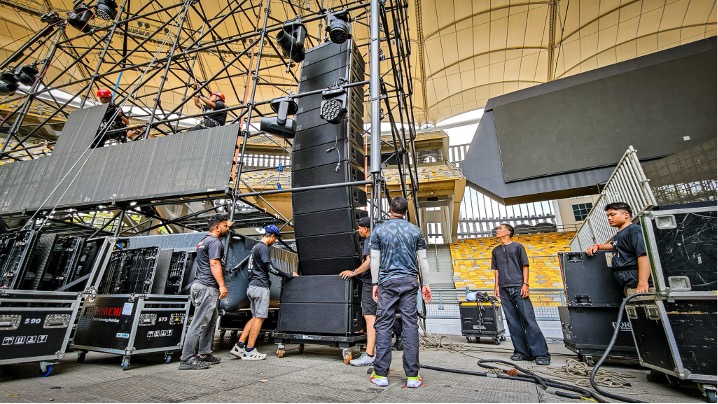
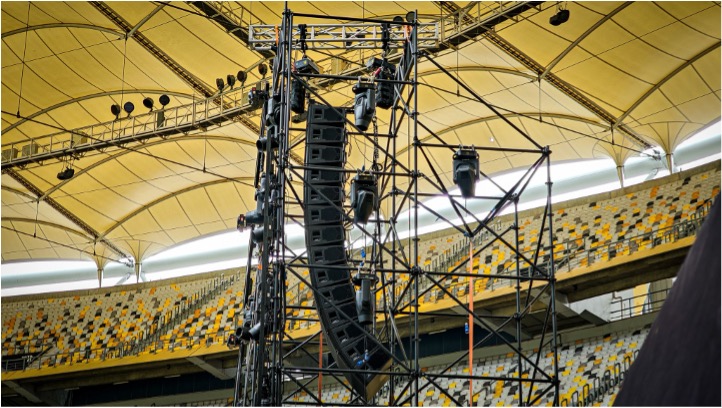
Line arrays solve these problems by changing how sound waves interact with each other. Instead of one large speaker emitting sound in all directions, a line array consists of multiple speaker modules stacked vertically and precisely angled creating a controlled wavefront known as cylindrical wave behaviour, rather than a spherical one.
Spherical vs Cylindrical Wave Propagation
| System Type | How Sound Spreads | Result Over Distance |
|---|---|---|
| Point Source (Spherical) | Outward in all directions | Energy drops rapidly significant loss in sound pressure level |
| Line Array (Cylindrical) | Controlled vertical pattern | Energy distributed more evenly reduced drop in sound pressure level |
Wave Coupling and Phase Alignment
One of the most important physical principles behind line arrays is constructive interference. When multiple speakers emit sound waves in phase, the waves combine and sound energy increases in a controlled direction. However, if not properly aligned, waves can cancel each other out (destructive interference), causing inconsistent or hollow sound. Line array systems are carefully engineered so each cabinet has precise timing, maintains correct phase relationships, and works as part of a unified acoustic system ensuring coherent wavefront formation.
The Role of Vertical Directivity
Line arrays are designed to control sound in the vertical plane while allowing wider horizontal coverage. By narrowing vertical dispersion, line arrays reduce ceiling reflections, minimise floor bounce, and focus energy toward audience seating significantly improving clarity in large indoor environments.
Why Large Halls Require Line Arrays
Large halls present unique acoustic challenges including long reverberation times, wide audience dispersion, high ceilings, and reflective architectural surfaces. Line arrays address these challenges by providing:
- Even sound distribution — every audience member receives consistent audio levels regardless of seating position.
- Controlled coverage zones — arrays can be physically curved (splayed) so upper cabinets cover rear seats while lower cabinets cover front rows.
- Reduced acoustic distortion — minimising unwanted reflections significantly improves speech intelligibility, vocal clarity, and music definition.
- Improved distance performance — unlike point-source speakers, line arrays maintain consistent sound pressure levels over long distances.
The Importance of Array Geometry
The physical arrangement of line array speakers plays a major role in system performance. Engineers carefully calculate cabinet angles, array curvature, height from ground, throw distance, and audience geometry. Improper setup can lead to coverage gaps, overlapping frequency zones, and uneven sound distribution. Modern design software is used to simulate sound propagation, SPL distribution, and frequency response across seating zones ensuring accurate deployment before installation.
Subwoofer Integration and Low-Frequency Control
Low-frequency sound behaves differently from high frequencies bass waves are omnidirectional, travel longer distances, and are less affected by obstacles. In large halls, uncontrolled bass can cause boomy sound, muddy clarity, and uneven bass distribution. To solve this, subwoofers are often configured in end-fire arrays or cardioid setups allowing engineers to control bass directionality, reduce stage noise, and improve audience clarity.
Time Alignment and Delay Systems
In very large halls, line arrays alone are not enough. Additional delay speakers are often used to reinforce sound in distant zones and maintain timing consistency. If sound from the main system arrives out of sync with delay speakers, it can cause echo perception, phase issues, and listener confusion. Digital Signal Processors (DSPs) calculate precise delay times to ensure perfect synchronisation.
Line Arrays in Speech vs Music Applications
| Application | Tuning Priorities |
|---|---|
| Speech-Focused Events Corporate, conferences, government forums |
High intelligibility, reduced reverberation, controlled volume levels |
| Music-Focused Events Concerts, festivals, gala entertainment |
Wide frequency response, dynamic range, bass impact, energy distribution |
Digital Processing and Modern Line Array Systems
Modern line arrays are deeply integrated with digital processing systems, relying on DSP controllers, networked audio (Dante by Audinate), remote monitoring software, and real-time system tuning. This allows engineers to adjust system parameters remotely, monitor speaker performance, apply EQ corrections per zone, and maintain consistent output during live events.
Real-World Applications in Large-Scale Events
Corporate Events
Events such as the Maybank Annual Dinner and Allianz Annual Dinner demonstrate how large ballroom environments rely on line arrays for speech clarity, entertainment audio, and balanced audience coverage across hundreds of tables.
Exhibitions and Conferences
Large-scale venues like MITEC regularly host events such as SEMICON Southeast Asia, DSA Exhibition and Conference, and MATTA Fair environments that require scalable line array systems to handle multiple halls, keynote stages, and simultaneous presentations.
Concerts and Live Entertainment
Events like the Carlsberg Music Festival and Music Run demonstrate how line arrays are essential for delivering powerful, controlled sound across large outdoor or hybrid audience environments where coverage and consistency are non-negotiable.
Common Mistakes in Line Array Deployment
- Incorrect array angling — Poor cabinet angles cause dead zones, overlapping frequencies, and uneven coverage across the audience area.
- Underpowered systems — Insufficient amplification leads to distortion, reduced clarity, and poor headroom during peak performance moments.
- Ignoring venue acoustics — Even the best system will underperform if room reflections, surfaces, and architectural features are not considered during design.
- Poor delay coordination — Without proper delay systems, large venues suffer from echo and timing inconsistencies that reduce intelligibility throughout the hall.
The Future of Line Array Technology
Line array systems continue to evolve rapidly. Future systems will likely become more automated, more adaptive to venue conditions, more efficient in energy usage, and more precise in spatial sound control:
Lighter Cabinet Materials
Smarter DSP Integration
AI-Assisted Tuning Systems
Predictive Acoustic Modelling
Networked Audio Ecosystems
Hybrid Immersive Audio Formats
Precision-Engineered Audio for Every Seat in the Hall
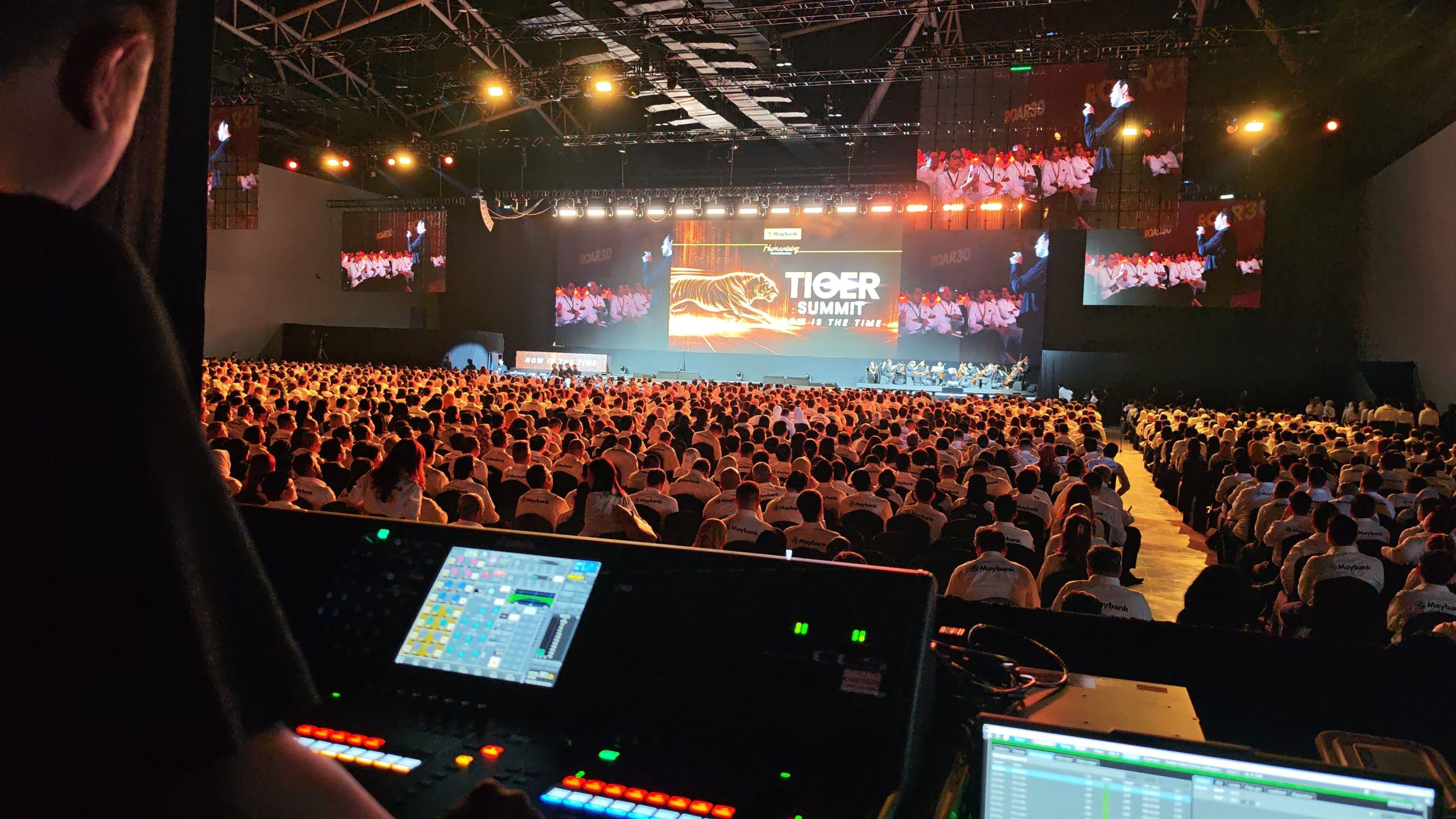
Line array systems are not just powerful speakers they are precision-engineered acoustic tools based on fundamental physics principles. By controlling wave propagation, phase alignment, and sound dispersion, they solve one of the most complex challenges in live event production: delivering clear, consistent, and evenly distributed sound across large audience spaces.
From corporate conferences and gala dinners to exhibitions and concerts, line arrays ensure that every listener regardless of where they are seated experiences the same clarity and impact. As event venues continue to grow in size and complexity, line array systems remain the backbone of professional sound reinforcement.
Need a Line Array System for Your Next Event?
Our audio engineers specialise in line array design, system modelling, subwoofer configuration, delay alignment, and full large-hall sound reinforcement delivering consistent coverage for audiences of any size.