Ever wondered why the person sitting 20 metres from the stage and the person sitting 120 metres away can both hear the same concert?
It is definitely not because someone simply turned the speakers up. In fact, if the solution to a 10,000-person stadium were just “add more speakers and make them louder,” sound engineers would have a much easier job.
A stadium is basically a giant acoustic puzzle. You have thousands of people spread across different distances and heights, seating that curves away from the stage, concrete surfaces waiting to throw sound back at you, and sometimes an entire neighbourhood outside the venue that you would rather not accidentally entertain.
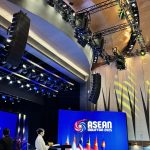
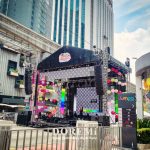
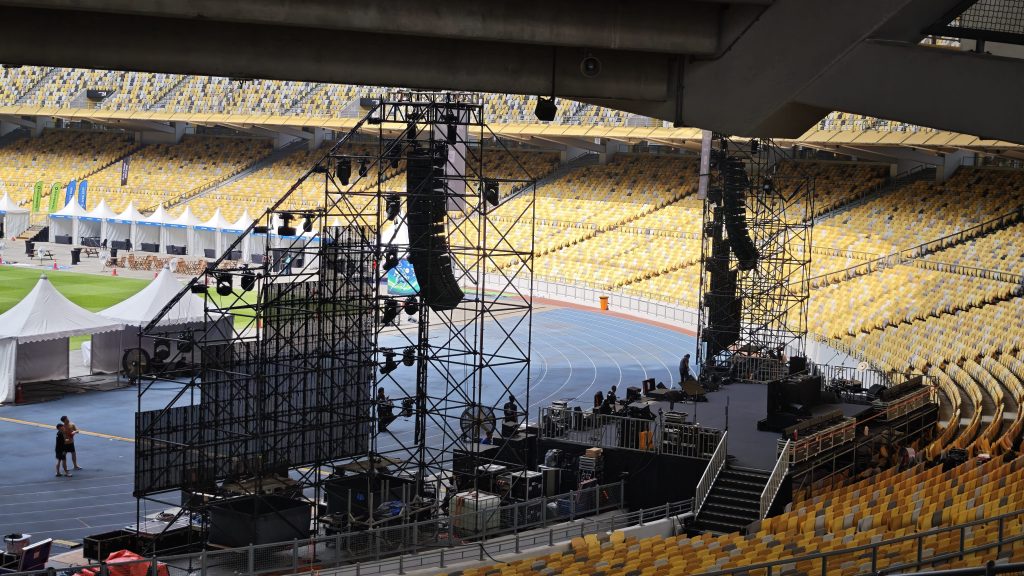
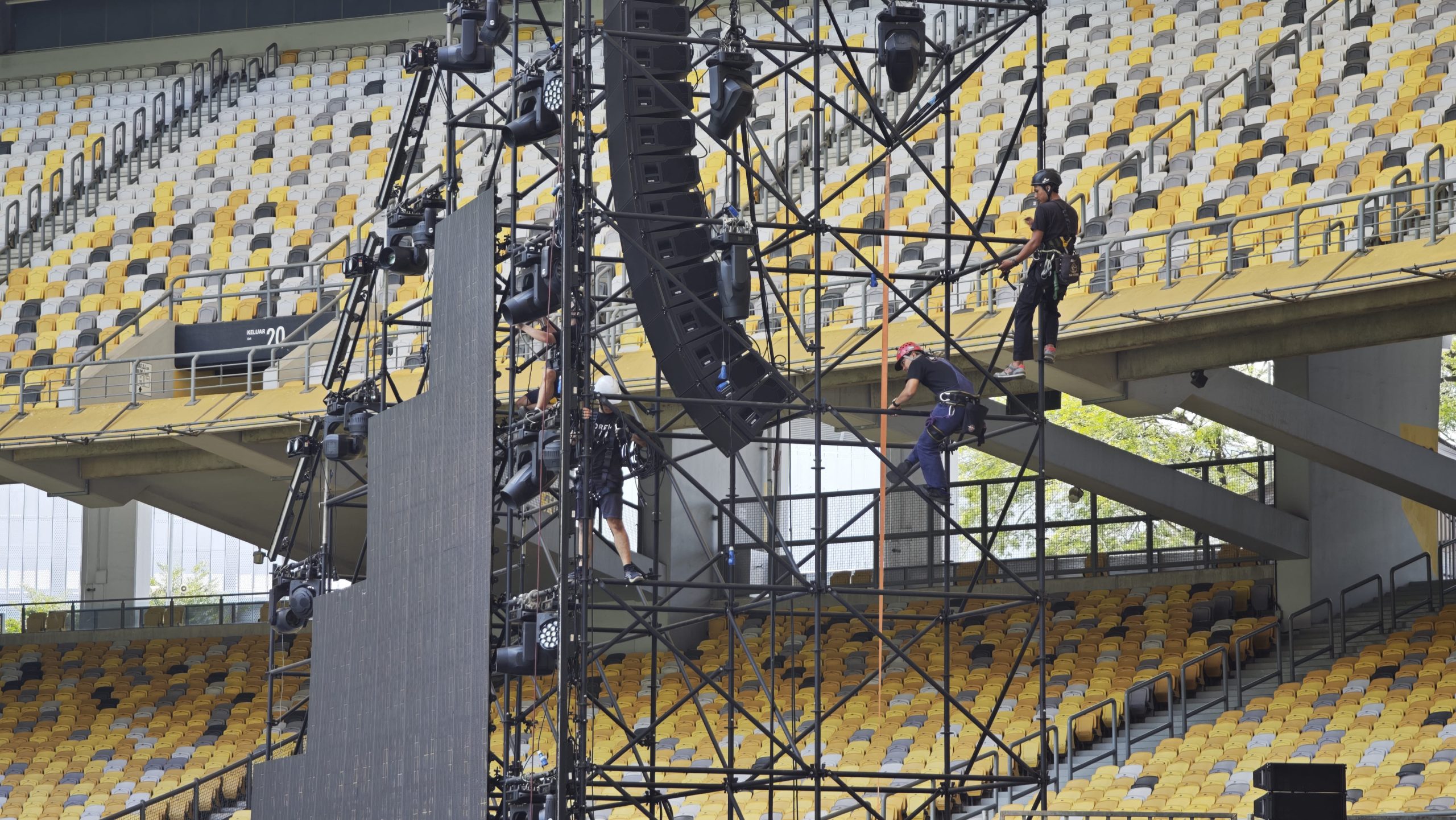
This is where line array speakers come in. You have probably seen them at concerts: those tall columns of loudspeaker cabinets suspended on either side of a stage, sometimes looking like a giant stack of black boxes hanging in mid-air. But they are not there just because they look impressive.
They are carefully engineered to control where the sound goes. A properly designed line array can provide broad horizontal coverage while keeping the vertical spread more controlled, helping engineers deliver sound to the audience rather than unnecessarily sending it into the ceiling, walls or other areas of the venue.
And when the audience is 10,000, 20,000 or even more people, that control becomes a very big deal.
Because the real challenge in stadium sound is not:
“Can we make it loud enough?”
It is:
“Can we make it sound good for everyone?”
That is where engineering gets interesting.
Why Stadium Sound Is So Difficult
In a small venue, the distance between the loudspeakers and the furthest listener may be relatively short. A stadium changes the equation completely. A large audience area can contain listeners at dramatically different distances and angles from the main loudspeaker system. If the system is not designed correctly, the front rows may receive excessive sound pressure while the rear sections struggle to hear clearly.
Then there is the architecture. Concrete seating tiers, roofs, walls and other large surfaces can reflect sound. Those reflections may arrive at the listener after the direct sound, reducing intelligibility and making music feel less precise.
Outdoor stadiums create another set of variables. Wind and atmospheric conditions can influence how sound propagates, while surrounding residential or commercial areas may impose noise-control requirements. This is why stadium audio engineering begins long before the speakers arrive at the venue.
Professional system designers can model loudspeaker positions, coverage, SPL distribution and system configuration before the physical installation. Tools such as L-Acoustics Soundvision and Meyer Sound MAPP 3D, for example, allow engineers to model venues and evaluate loudspeaker placement and predicted coverage.
The goal is to identify potential problems during the design stage rather than discovering them in front of a live audience.
What Is a Line Array?
A line array is a group of loudspeaker elements arranged vertically and operated together as an acoustic system.
Instead of treating every speaker as an isolated sound source, multiple elements are carefully positioned and processed so that the array produces controlled coverage.
One of the major advantages is vertical directivity. A properly designed line array can concentrate acoustic energy into the intended audience area while reducing unnecessary energy travelling above or below it. The exact behaviour depends on the loudspeaker design, array length, element spacing, splay angles, frequency and processing.
The Audio Engineering Society has highlighted that modular line arrays can provide relatively narrow vertical coverage and useful long-distance performance when correctly configured, while also noting that their real-world performance depends heavily on deployment and system design.
In other words, a line array is not simply a collection of speakers hanging together.
The configuration is part of the engineering.
The Importance of Array Geometry
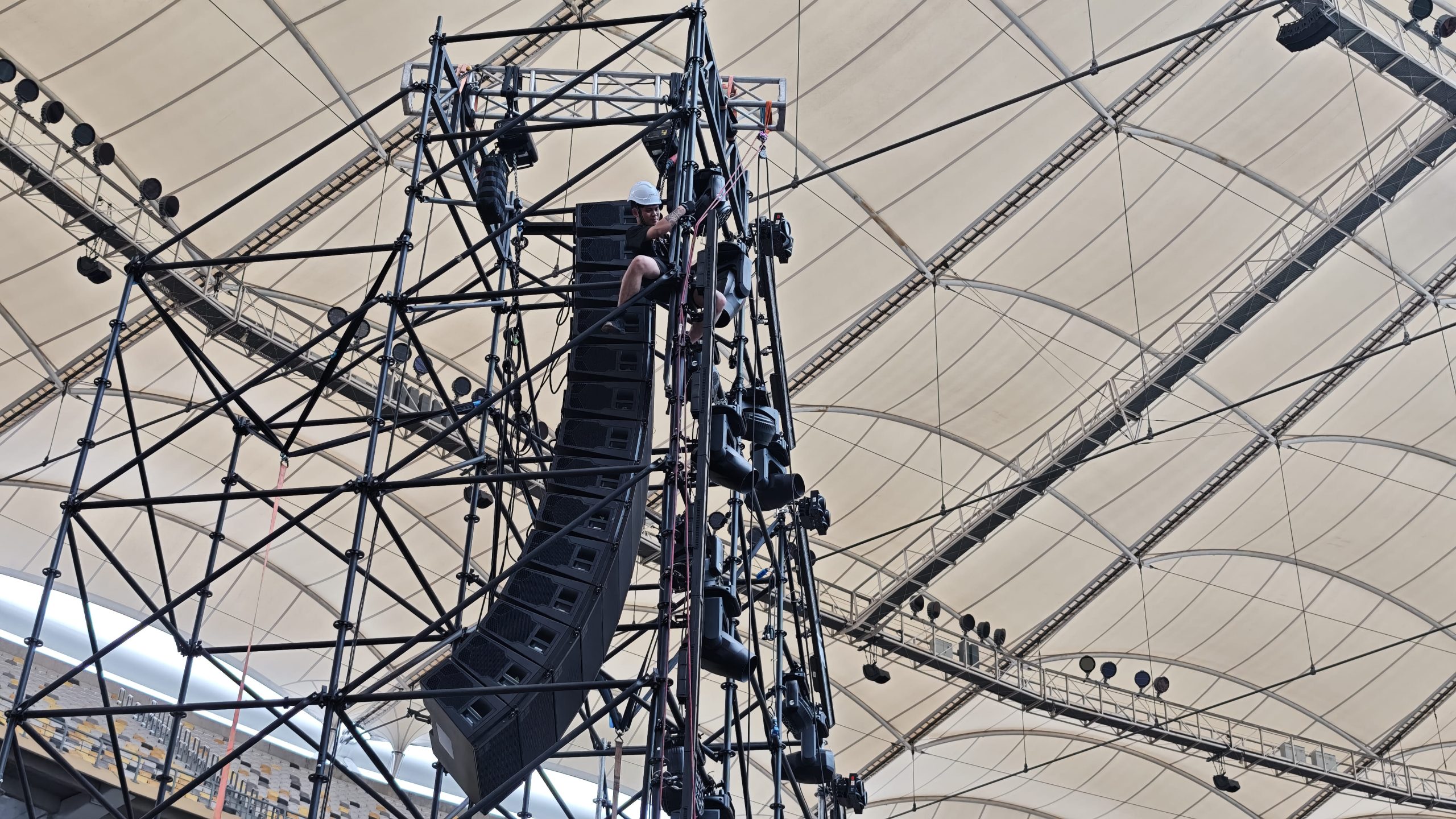
One of the most important decisions in a stadium sound system is how the individual loudspeaker cabinets are angled relative to one another.
This is known as the splay angle. Imagine a vertical array positioned above the stage. The upper sections may need to project towards distant upper seating, while the lower sections may need to cover the audience closer to the stage.
If every cabinet pointed in exactly the same direction, the system would not necessarily provide the desired coverage. Instead, engineers adjust the angles between elements to shape the vertical coverage.
Modern prediction software can help determine those angles. L-Acoustics’ Soundvision, for example, includes an Autosplay function designed to optimise the mechanical arrangement of line-source elements against a target SPL distribution. Meyer Sound similarly notes that inter-element splay angles significantly affect line-array coverage, while array length, trim height and other parameters influence low-frequency vertical behaviour.
This is one reason why professional line array setup cannot be reduced to a simple “more boxes = more sound” formula. The number of cabinets, their angle, height, horizontal coverage, processing and relationship with other loudspeakers all matter.
Coverage Matters More Than Sheer Volume
A common misconception about large event audio is that the main goal is maximum SPL. In reality, a well-designed stadium system is concerned with consistent coverage.
Suppose the audience area extends from 20 metres to 120 metres from the stage. If the system is designed simply to reach the back, the front section could receive excessive energy. Conversely, if the system is optimised only for the closest audience members, the rear seating may lack sufficient level and clarity. The engineer therefore needs to consider the entire listening area.
A useful system design asks:
Where is the closest audience member?
Where is the furthest listener?
What are the seating elevations?
How wide is the audience area?
Where are the stage left and stage right boundaries?
Are there balconies or upper tiers?
Are there roof structures or reflective surfaces?
Which areas require additional fill or delay speakers?
What level and tonal consistency should be achieved across the audience?
These questions are more important than simply asking how many speakers are required.
Main Arrays, Fills and Delay Systems
A stadium rarely relies on a single pair of loudspeaker arrays to cover every listener.
The main line arrays normally provide the primary sound coverage, particularly across the central audience area.
However, some sections may be too far away, too wide, too low or positioned at an angle that makes them difficult for the main system to cover efficiently.
This is where fill and delay loudspeakers become valuable.
Front fills
Front fills can be positioned close to the stage to cover audience members who are too close to the main arrays or located in areas where the main system does not provide ideal coverage.
Side fills
Side fills can support audience areas positioned significantly to the left or right of the main stage coverage.
Delay systems
Delay systems are positioned further into the audience area and electronically time-aligned with the main system. The principle is straightforward: rather than asking the main array to throw all the way to the back of a huge venue, additional loudspeakers can reinforce distant sections.
The timing relationship is critical. If a delay speaker reproduces the signal too early or too late relative to the main system, listeners may perceive echoes or reduced clarity rather than a seamless reinforcement system. Modern system-design software can assist engineers with delay calculations and alignment. L-Acoustics Soundvision, for example, includes delay-mode tools intended to help prepare system calibration and align sources.
Why Subwoofers Are a Different Engineering Challenge
The main line array is only part of the system. For concerts and entertainment events, low-frequency reproduction is responsible for much of the physical impact audiences associate with kick drums, bass guitars, electronic music and cinematic effects.
This is where subwoofers enter the picture. But simply adding more subwoofers does not automatically produce better bass.
Low-frequency sound behaves differently from mid and high frequencies. Engineers have to consider how subwoofers interact with one another, the stage, the audience area and surrounding structures. One increasingly important approach is cardioid subwoofer arrays.
Cardioid configurations are designed to reduce unwanted low-frequency radiation behind the system while maintaining useful output towards the audience. d&b audiotechnik, for example, describes cardioid subwoofer designs as a way of reducing unwanted energy behind the system and limiting excitation of the reverberant field.
This can be particularly useful in stadium environments where the production team needs powerful low-frequency impact in the audience area without unnecessarily sending energy towards the stage, backstage areas or surrounding environment.
Sound Prediction: Designing Before the Rig Goes Up
One of the biggest developments in modern event audio is the use of 3D sound system prediction software. Instead of relying exclusively on experience and trial-and-error, engineers can construct a digital representation of the venue and model different loudspeaker configurations.
For example, a design process can evaluate:
Venue geometryAudience areasLoudspeaker locationsArray angles
Trim heightsCoverage patternsSPL distributionDelay speaker positions
Subwoofer configurationsPotential sound spill
L-Acoustics’ Soundvision allows designers to position loudspeakers, line arrays and subwoofers in a 3D environment and assess predicted SPL distribution across the audience. Meyer Sound’s MAPP 3D similarly provides tools for creating venue models, positioning loudspeakers and microphones, and evaluating system designs. Its documentation specifically describes modelling line-array directivity and the influence of array geometry.
For outdoor events, environmental noise can also become part of the planning process. d&b’s NoizCalc, for example, can model sound propagation from complex systems including line arrays, subwoofer arrays, fills and delays and produce noise prediction maps using recognised calculation standards.
This is important because a successful event is not only about what happens inside the stadium. It can also be about controlling what happens outside it.
Managing Sound Spill Beyond the Stadium
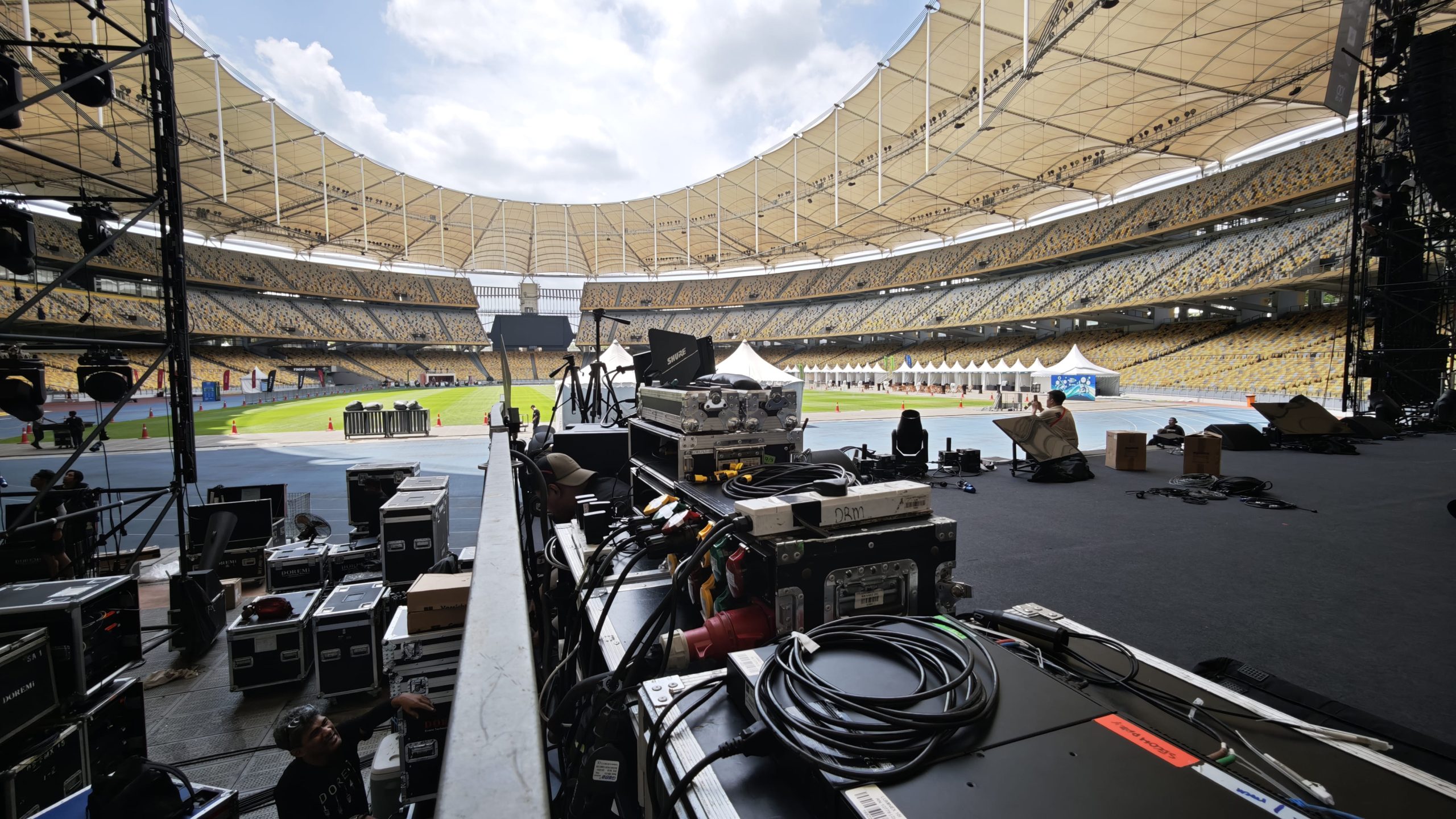
Large events can generate substantial sound levels, and stadiums are often located close to roads, residential developments, commercial buildings or other public spaces. Sound engineers therefore have to consider sound containment and directivity alongside audience coverage. A highly directional system can help concentrate acoustic energy where it is required rather than allowing unnecessary energy to spread into surrounding areas.
This is becoming increasingly important as stadiums operate as multi-purpose entertainment venues. Modern stadiums may host sports, concerts, festivals, corporate events and other productions, meaning audio systems have to balance audience experience with environmental considerations.
A real-world example can be seen at Forest Hills Stadium in New York, where an L-Acoustics system upgrade used controlled directivity to improve audience coverage while reducing off-site sound levels. The project reported reductions in off-site noise of approximately 10–15 dB.
The takeaway is important:
Good stadium audio does not mean sound everywhere. It means sound where it is supposed to be.
Real-World Stadium Engineering
Large-scale audio installations demonstrate just how sophisticated modern stadium sound has become. At Allianz Arena in Munich, for example, L-Acoustics describes a stadium system consisting of hundreds of line-source elements, dozens of subwoofers and numerous delay arrays. The design had to account for the venue’s membrane roof, reverberation, weight restrictions and sightline requirements.
At Chengdu Phoenix Mountain Indoor Stadium, an 18,000-seat venue, the main system uses multiple arrays to provide 360-degree coverage, supported by flown subwoofers. The system was modelled using Soundvision to evaluate coverage and SPL throughout the audience.
These projects illustrate an important point: stadium sound is rarely a one-size-fits-all solution. Two venues with similar capacities can require completely different systems because of their geometry, architecture, audience layout and event requirements.
The Role of DSP and System Processing
Modern line arrays also depend heavily on digital signal processing (DSP).
DSP allows engineers to control and optimise aspects of the system including:
Crossover pointsGainDelayLimitingPhase relationshipsArray processing
System protectionFrequency response
The physical loudspeaker is therefore only one part of the modern sound reinforcement chain. The system designer is effectively controlling an interconnected network of acoustic sources.
This also makes system monitoring important. Large concerts may involve numerous amplifier channels, networked audio systems and loudspeaker elements, so engineers need reliable monitoring and control throughout the event.
Modern touring productions demonstrate the scale of this technology. Meyer Sound’s documentation on Ed Sheeran’s + – = ÷ x tour, for example, describes the use of 212 PANTHER line-array loudspeakers and networked signal distribution, with MAPP 3D helping engineers adapt coverage for different stadium configurations.
Why Rigging Is Part of the Audio Design
There is another component audiences rarely think about: rigging. Large line arrays are suspended above the audience, which means the mechanical design and installation are fundamental parts of the system.
Engineers and production teams have to consider:
- Array weight
- Rigging points
- Motor positions
- Load calculations
- Trim height
- Structural limitations
- Safety factors
- Wind conditions for outdoor productions
- Sightlines
- Access for installation and removal
The acoustic design cannot be separated from the physical structure supporting it. The ideal acoustic position is not necessarily possible if the venue’s rigging points cannot safely support the required load.
That is why venue information and structural planning should be part of the production conversation early.
Measurement: Prediction Meets Reality
Prediction software is powerful, but the job does not end once the system is installed. After the system is physically deployed, engineers can measure its real-world behaviour and make adjustments.
Measurement microphones and system-analysis tools can help engineers evaluate frequency response, timing and SPL across different audience positions. This process is particularly important because real venues are not perfect computer models.
There may be unexpected reflections, structural obstructions, environmental conditions, audience effects and changes in the physical setup.
The best workflow is therefore:
Design → Predict → Deploy → Measure → Optimise → Monitor
It is an engineering process rather than a simple equipment setup.
What Should Event Organisers Ask Their Audio Supplier?
If you are organising a concert, festival, corporate event or large-scale stadium production, you do not necessarily need to understand every technical detail of line-array theory.
But asking the right questions can help you evaluate whether your production partner has properly planned the audio system.
Consider asking:
1. Has the venue been modelled?
A professional system design should take the actual audience area and venue geometry into consideration.
2. How will the rear seating be covered?
Ask whether the main arrays can adequately cover the back sections or whether delay systems are required.
3. How will the low frequencies be managed?
For concerts and music-heavy events, subwoofer configuration is an important part of the overall experience.
4. What happens outside the venue?
If noise restrictions apply, ask how sound spill will be managed.
5. Is the system scalable?
A 10,000-person corporate event and a 20,000-person concert may require very different configurations.
6. How will the system be aligned?
Timing and phase relationships between main arrays, fills and delays can have a significant effect on consistency.
7. What is the contingency plan?
Large events need redundancy and a clear plan for equipment failure, weather considerations and operational issues.
10,000+ People Does Not Automatically Mean “More Speakers”
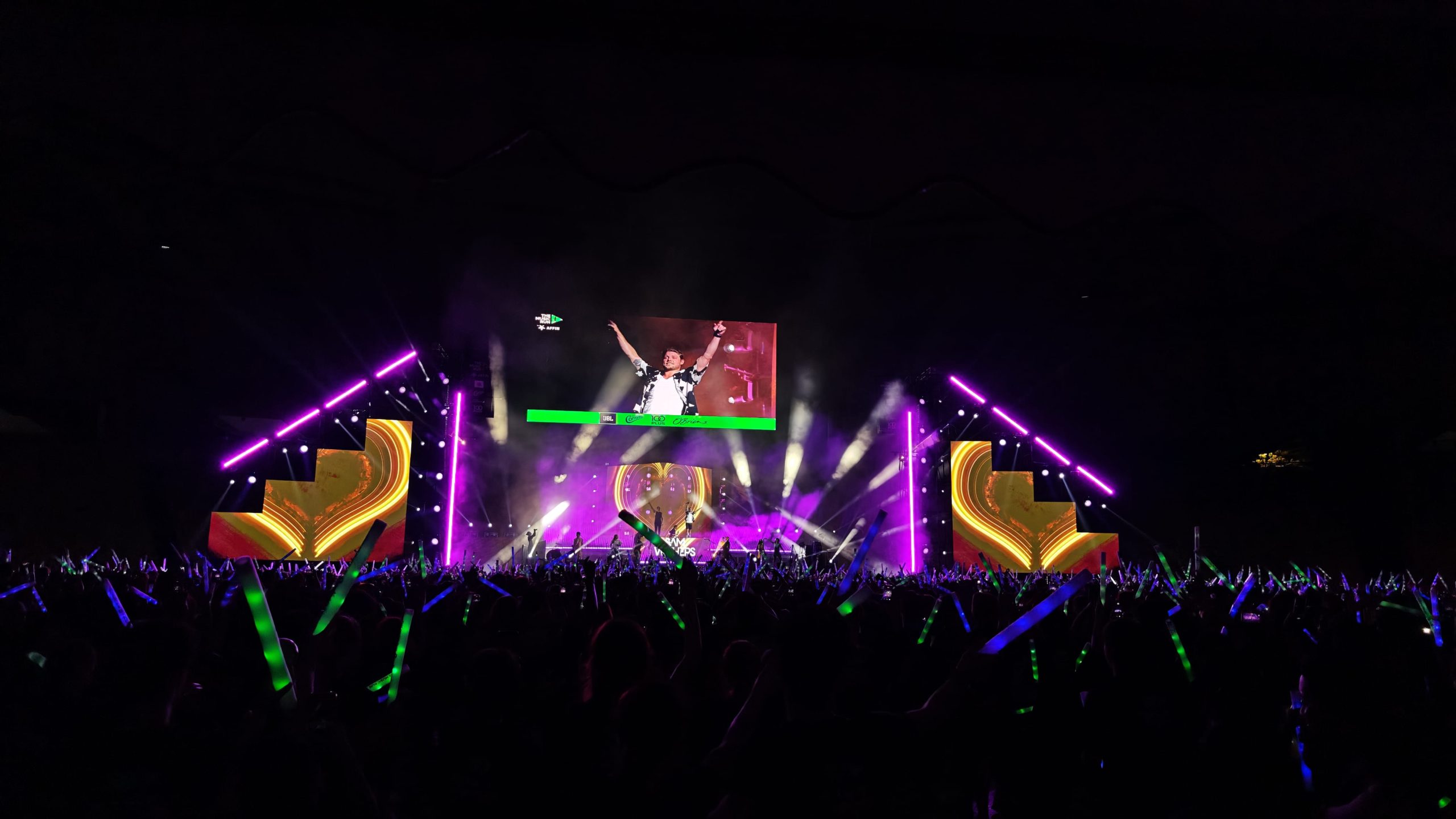
This is perhaps the most important lesson in large-format audio. Audience capacity is an important starting point, but it is not enough to determine a sound system.
A 10,000-person event could take place in a compact indoor arena, an open football stadium, a large festival field or a temporary outdoor structure. Each environment creates different acoustic and logistical requirements.
The right system is determined by the venue, audience geometry, event content, coverage requirements, sound levels, production design and environmental constraints.
That is why professional audio companies design systems around the event rather than simply selecting equipment based on crowd size.
From the Audience Perspective, Great Audio Should Feel Effortless
The irony of good sound engineering is that the audience should not notice the engineering.
They should notice the performance.
The vocalist should sound clear.
The band should feel powerful without becoming harsh.
The bass should have impact without turning into uncontrolled rumble.
The presenter should remain intelligible.
The audience at the back should not feel forgotten.
And the person sitting near the side of the stadium should still feel like they are part of the event.
Achieving that experience for 10,000, 20,000 or more people requires much more than powerful loudspeakers.
It requires acoustic planning, controlled directivity, precise system design, intelligent deployment, careful alignment and experienced engineers.
The Future of Large-Scale Event Audio
The direction of professional live sound is increasingly focused on precision rather than brute force.
Newer loudspeaker designs are placing greater emphasis on directivity control, cardioid behaviour, prediction software, networked control and system optimisation.
In May 2026, L-Acoustics introduced its L1 and CS1 systems, describing the L1 as a large-format line-array system developed for major stages and stadium-scale applications. The company also highlighted deployments on major touring productions.
Meanwhile, software continues to become an increasingly important part of the production workflow. Prediction, optimisation, networking and monitoring allow engineers to make more informed decisions before and during an event.
The result is a shift from simply asking:
“How powerful is the sound system?”
to asking:
“How accurately can we control the sound system?”
That distinction matters.
Bringing Stadium-Scale Thinking to Your Next Event
Whether the audience is 500 people in a ballroom or 15,000 people in a stadium, professional event audio begins with understanding the space and the experience you want to create. For large audiences, line arrays can provide the controlled coverage and scalability required for modern concerts, festivals, sporting events and major corporate productions—but only when they are correctly designed, deployed and tuned.
At DOREMi Events, the focus is not simply on putting speakers at the front of a stage. Event audio should support the entire production: the venue, audience, performers, programme and overall event experience.
For large-scale productions, the right questions should be asked before the first speaker is flown, the first cable is connected or the first guest walks through the gate. Because when 10,000 people are listening, there is no such thing as a small sound problem.
And when the engineering is done right, the audience does not think about the speakers at all. They simply hear the show.