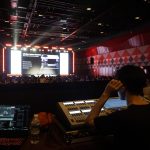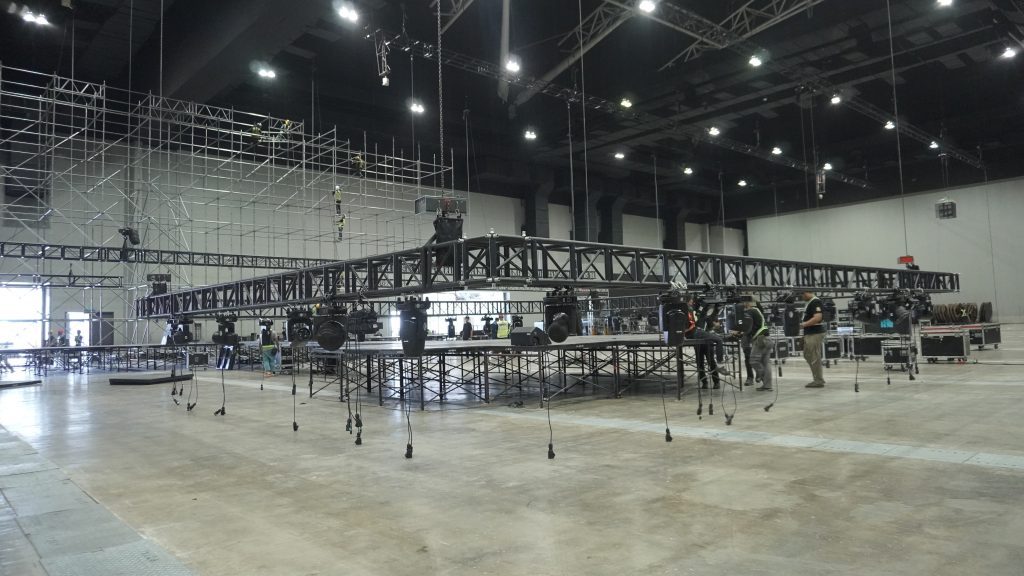
Walk into a major exhibition, conference or corporate event at Kuala Lumpur Convention Centre (KLCC) or Malaysia International Trade and Exhibition Centre (MITEC), and look above the audience.
You may see hundreds of kilograms of equipment suspended overhead:
- LED screens
- Line-array speakers
- Moving lights
- Profile lights
- Trussing
- Projectors
- Decorative structures
- Signage
- Special effects equipment
From the audience’s perspective, the equipment may appear to be simply hanging from the ceiling.
Behind the scenes, however, there is a considerable amount of engineering and planning involved.
For professional event rigging Malaysia, one of the most important concepts is the point load.
Every suspended system transfers its weight through specific rigging points. Understanding how that load is distributed—and ensuring that the proposed load remains within the approved capacity of the venue and rigging system—is fundamental to safe event production.
This is why professional event rigging is not simply about finding a suitable place to hang equipment.
It involves understanding weight, load distribution, geometry, hardware, structural capacity, safety factors, venue requirements and installation procedures.
For events at major venues such as KLCC and MITEC, this becomes particularly important because large-scale productions can involve substantial suspended equipment and complex temporary structures.
What Is Point-Load Rigging?
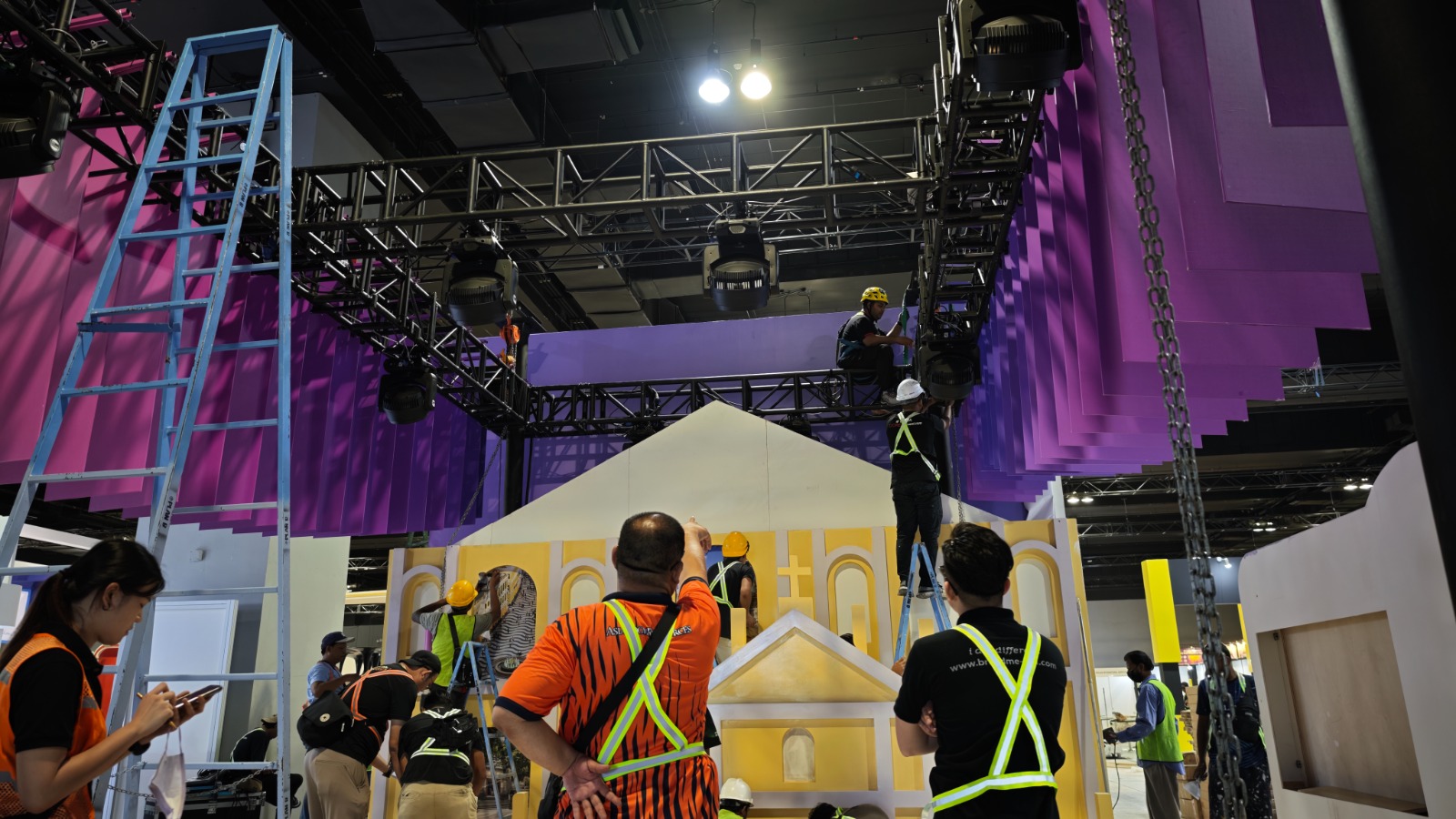
A point load is a load concentrated at a particular location on a structure.
In event production, this usually refers to the load transferred into an individual overhead rigging point.
For example, imagine a lighting truss suspended from four points.
The truss itself has weight.
Then several moving lights are attached to it.
Perhaps there are LED fixtures, cables and other equipment as well.
All of that combined weight eventually transfers through the suspension points into the venue’s overhead structure.
The load at each point is therefore critical.
A simplified example might look like this:
Truss weight: 300 kg
Lighting equipment: 500 kg
Cables and accessories: 100 kg
Additional equipment: 100 kg
Total suspended load: 1,000 kg
If the load were perfectly centred and distributed equally across four points:
1,000 kg ÷ 4 = 250 kg per point
That calculation is useful for understanding the basic principle.
However, it should not be treated as a real-world rigging approval calculation.
Actual event rigging is more complicated because loads are rarely perfectly symmetrical.
The position of each item, truss geometry, suspension arrangement, sling angles, dynamic forces and structural limitations can all affect the actual load transferred to each point.
That is where professional rigging design becomes essential.
Why Point Loads Matter in Event Production
The biggest misconception about overhead rigging is that the total weight of the equipment is the only number that matters.
It is not.
A structure may be capable of supporting a particular total load, but that does not necessarily mean every individual rigging point can support an arbitrary portion of that load.
Consider a 1,000 kg production system.
If it is evenly distributed across four suitable points:
1,000 kg ÷ 4 = 250 kg per point
But suppose most of the equipment is concentrated near one end of the truss.
The load distribution may no longer be equal.
One point could carry significantly more than another.
This is why professional event rigging Malaysia requires more than adding up equipment weights.
The rigging team needs to understand where the weight is located and how the structure transfers that weight.
Static Load vs Dynamic Load
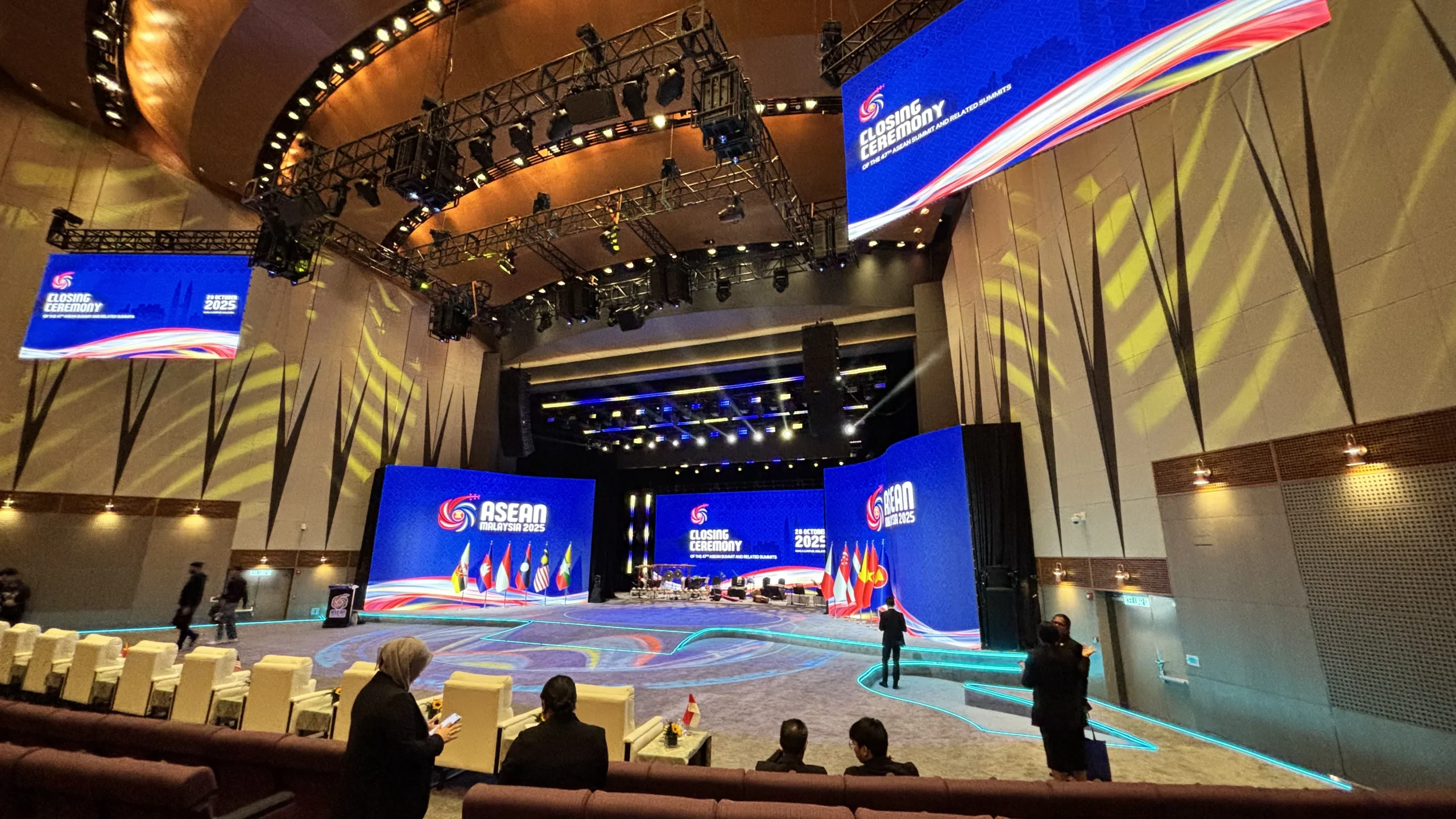
Another important distinction is between static and dynamic loading.
Static Load
Static load is essentially the weight of equipment that is stationary.
For example:
- A stationary LED screen
- A fixed lighting fixture
- A stationary speaker
- A truss
The weight acts downward due to gravity.
Dynamic Load
Dynamic loads can occur when equipment moves, accelerates, stops or is otherwise subjected to changing forces.
For example:
- Motorised truss movement
- Moving scenic elements
- Equipment being raised or lowered
- Impact or sudden movement
- Wind affecting outdoor suspended structures
The forces involved can therefore be different from simply measuring the equipment’s mass.
This is why professional rigging calculations should not be reduced to:
“The equipment weighs 100 kg, so the rigging point carries 100 kg.”
The actual engineering assessment depends on the configuration and operating conditions.
The Basic Mathematics Behind a Rigging System
At the most basic level, event rigging starts with identifying the total suspended weight.
A simplified equation is:
Total Load = Equipment + Truss + Rigging Hardware + Cables + Accessories
Suppose a temporary truss contains:
- 400 kg of LED equipment
- 300 kg of lighting
- 250 kg of speakers
- 200 kg of truss
- 100 kg of cables and accessories
The total would be:
400 + 300 + 250 + 200 + 100 = 1,250 kg
That is the starting point.
The next question is:
How is the 1,250 kg distributed across the suspension points?
If there are four points and the load is perfectly symmetrical:
1,250 ÷ 4 = 312.5 kg per point
Again, this is only a simplified static calculation.
Real rigging calculations must consider the actual geometry and load distribution.
Why Equal Number of Points Does Not Mean Equal Loading
This is where point-load rigging becomes more interesting.
Imagine a six-metre truss suspended from two points.
The truss carries:
- A heavy LED screen near the centre
- Several lights toward the left
- Several lights toward the right
If the equipment is balanced, the reactions at the two supports may be relatively similar.
Now move the LED screen closer to the left support.
The centre of gravity shifts.
The left support will experience a higher reaction while the right support experiences a lower reaction.
This is a basic principle of structural mechanics.
The position of the load matters.
A simplified beam model can be represented using moments.
For a beam supported at two points:
R₁ + R₂ = W
where:
- R₁ = reaction at support 1
- R₂ = reaction at support 2
- W = total load
The distribution between the two supports depends on where the load is positioned.
This is why experienced riggers look at the actual equipment layout, not just the total equipment weight.
Centre of Gravity: The Hidden Factor
The centre of gravity (CoG) is one of the most important concepts in rigging.
In simple terms, it is the point where the combined weight of the system can be considered to act.
If the suspended load is evenly distributed, the centre of gravity may be close to the geometric centre.
But when heavy equipment is concentrated in one area, the centre of gravity shifts.
For example, consider a truss carrying:
- Large LED panels on one side
- Several moving lights in the centre
- Speakers on the opposite side
The weight distribution may not be symmetrical.
The rigging arrangement must therefore account for the resulting centre of gravity.
If the suspension points are not positioned appropriately, the truss may experience uneven reactions or undesirable rotation.
This is one reason professional event rigging Malaysia requires careful planning before installation begins.
Truss Is Not Just a Piece of Metal
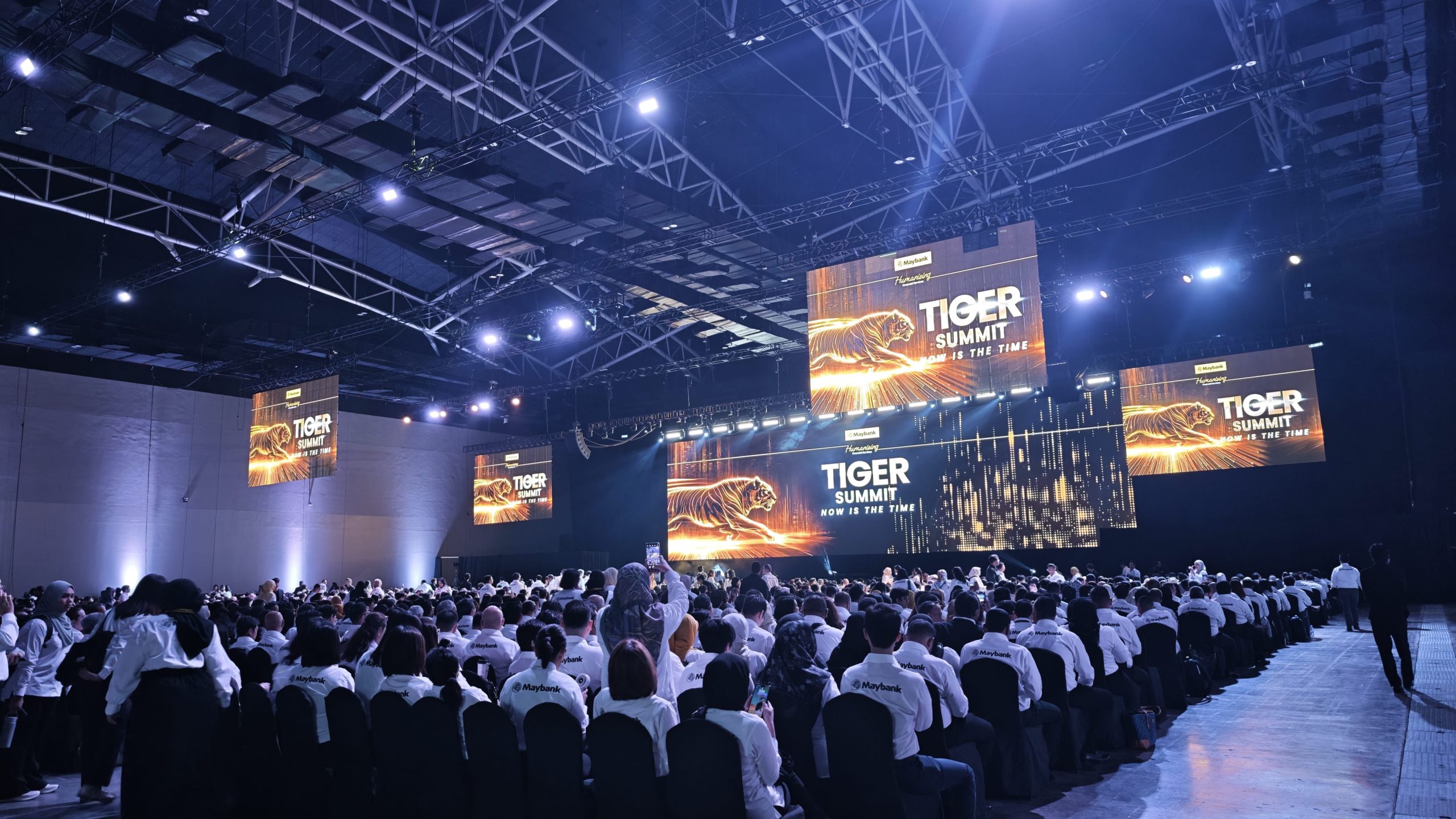
Event trussing is often misunderstood as simply a structure from which equipment can be hung.
In reality, a truss is a structural system.
Its ability to support equipment depends on factors such as:
- Truss type
- Span
- Loading arrangement
- Point loads
- Uniform loads
- Support locations
- Connections
- Manufacturer specifications
- Structural configuration
A truss with a particular load rating does not necessarily mean that any equipment can be attached anywhere along its length.
The location and magnitude of point loads matter.
For example, putting a very heavy LED structure near a support may produce a very different structural response from placing the same load at the centre of a long span.
Therefore, professional event rigging Malaysia should consider both the truss and the equipment attached to it as part of one structural system.
The Importance of Working Load Limits
Rigging hardware is also subject to rated capacities.
Depending on the application, a rigging system can include:
- Steel wire rope
- Slings
- Shackles
- Hoists
- Clamps
- Connectors
- Rigging points
- Safety attachments
Each component needs to be appropriate for the application and used according to its manufacturer’s requirements and applicable safety procedures.
A key term is Working Load Limit (WLL).
WLL is not simply the breaking strength of an item.
It represents the allowable working capacity under specified conditions.
This distinction is critical.
If a component has a high ultimate breaking load, that does not mean the system should operate continuously at that load.
Professional rigging considers appropriate safety margins and the limitations of each component.
Sling Angles Can Change the Forces
One of the most important mathematical concepts in rigging is the effect of sling angle.
Consider a load suspended using a two-leg sling.
The tension in each leg does not necessarily equal half the load.
As the sling angle becomes more horizontal, the tension in the sling legs increases.
A simplified relationship can be expressed as:
T = W / (2 × sin θ)
where:
- T = tension in each sling leg
- W = suspended load
- θ = sling angle measured from the horizontal
This equation demonstrates why sling geometry matters.
For example, if a 1,000 kg load is suspended with two legs at a 60° angle from the horizontal:
T = 1,000 / (2 × sin 60°)
Since sin 60° is approximately 0.866:
T ≈ 577 kg per leg
The important lesson is not the specific number.
It is that the force within the rigging components can be substantially different from simply dividing the load by two.
As the sling becomes flatter, the tension increases.
This is one of the reasons rigging angles must be carefully considered during system design.
Why Venue Rigging Points Are Not Interchangeable
A major venue may contain numerous overhead rigging positions.
It can be tempting to think:
“There are plenty of points, so we can use whichever ones are convenient.”
That is not how professional rigging works.
Each venue has its own structural infrastructure, approved rigging procedures and requirements.
The permitted use of rigging points depends on the venue’s documentation and approval process.
For events at KLCC, MITEC or other major Malaysian venues, production teams need to coordinate with the venue and follow the applicable rigging procedures rather than assuming that a point can support a particular load.
This is particularly important when the production design changes after the initial quotation.
A heavier LED configuration, additional speaker system or larger lighting rig can change the load calculation.
KLCC and MITEC: Why Venue Coordination Matters
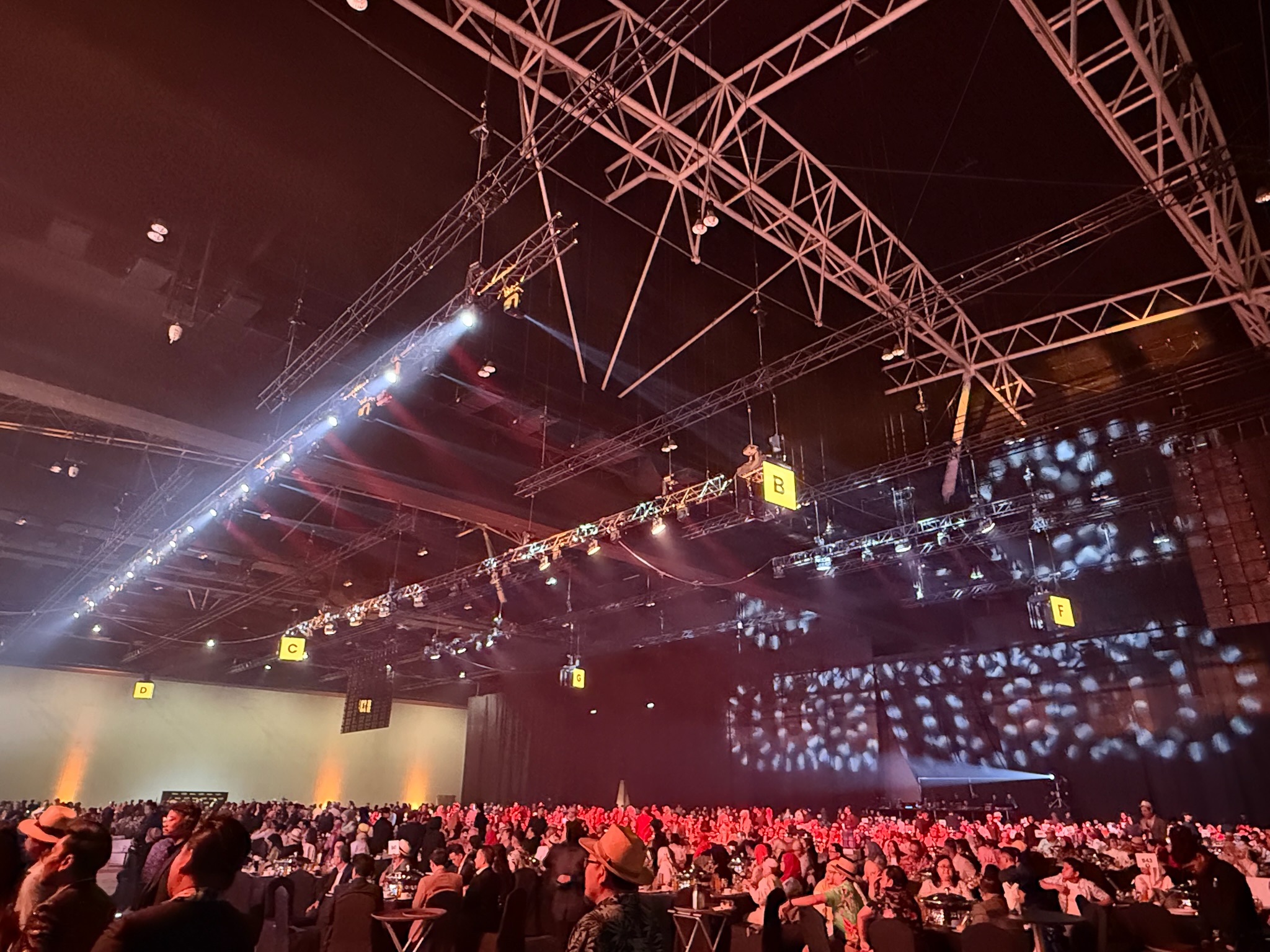
Large-scale venues such as Kuala Lumpur Convention Centre (KLCC) and Malaysia International Trade and Exhibition Centre (MITEC) regularly host conferences, exhibitions, corporate events and large productions.
These environments often involve sophisticated temporary installations.
The event production company therefore needs to coordinate the proposed rigging arrangement with the venue’s technical and operational requirements.
A professional workflow may involve:
Event brief
↓
Production design
↓
Equipment selection
↓
Equipment weights
↓
Truss and rigging layout
↓
Load calculations
↓
Rigging-point requirements
↓
Venue submission/approval
↓
Installation
↓
Inspection
↓
Event operation
This process is particularly important when heavy equipment is suspended above occupied areas.
The exact approved point capacities and conditions should always come from the venue’s current technical documentation rather than assumptions or generic internet figures.
What Happens When the Load Is Too Concentrated?
Suppose a production designer wants to hang a large LED screen from a truss.
The total system may appear acceptable when viewed as one overall weight.
But the actual load may be concentrated at only two or three locations.
That creates a point-load problem.
For example:
Total suspended system = 1,200 kg
The design team initially assumes four points:
1,200 ÷ 4 = 300 kg per point
But the actual LED screen and truss configuration might cause one point to carry considerably more than 300 kg.
The result is that the simple average is not sufficient.
This is why professional rigging calculations consider the actual geometry and load paths.
Load Path: Where Does the Weight Go?
A useful way to understand rigging is to follow the load path.
Imagine a moving light attached to a truss.
Its weight travels:
Moving light
↓
Clamp / attachment
↓
Truss
↓
Suspension connection
↓
Hoist / sling / rigging hardware
↓
Venue rigging point
↓
Building structure
Every component in that chain matters.
If one component is inappropriate or overloaded, the entire system can be compromised.
This is why event rigging should always be treated as a complete system rather than a collection of individual parts.
Why Equipment Weight Data Must Be Accurate
Rigging calculations are only as reliable as the information used to create them.
Equipment weight should therefore be properly identified.
For example, an LED display might have:
- Panel weight
- Frame weight
- Processor weight
- Mounting hardware
- Cabling
- Additional structural components
Similarly, a speaker system may include:
- Loudspeaker cabinets
- Rigging frames
- Pins
- Shackles
- Motors
- Cables
The production team needs to understand what is actually being suspended.
Underestimating equipment weight can produce an unsafe calculation.
This is why professional event rigging Malaysia requires proper equipment documentation and accurate production drawings.
Why Rigging Drawings Are Important
A professional rigging plan should communicate much more than “hang the truss here.”
Depending on the project, documentation may identify:
- Rigging-point locations
- Truss dimensions
- Equipment positions
- Point loads
- Equipment weights
- Hoist positions
- Suspension arrangements
- Load distribution
- Safety considerations
This gives the venue and production team a common technical reference.
It also reduces the possibility of misunderstandings during installation.
For major events, the rigging plan should be developed before equipment arrives on-site.
What Happens During the On-Site Rigging Process?
Once the rigging design has been approved, the physical installation begins.
A typical process can include:
1. Site Verification
The team confirms that the actual venue conditions match the planned rigging arrangement.
2. Point Identification
Approved rigging positions are identified according to the venue’s requirements.
3. Equipment Preparation
Trusses, hoists, cables, lighting fixtures, LED components and other equipment are prepared.
4. Installation
The rigging system is assembled according to the approved design.
5. Load Installation
Equipment is attached according to the planned load distribution.
6. Inspection
Connections, hardware, equipment attachment and overall configuration are checked.
7. Final Positioning
The truss or suspended equipment is raised and positioned as required.
8. Operational Checks
The system is checked before the event begins.
The objective is not simply to get the equipment into the air.
The objective is to ensure the entire suspended system has been installed according to the approved design and safety requirements.
Common Rigging Mistakes
Several mistakes can create unnecessary risk.
Mistake 1: Looking Only at Total Weight
A 1,000 kg system does not automatically mean 250 kg per point just because four points exist.
Load distribution must be assessed.
Mistake 2: Ignoring Equipment Position
Moving a heavy LED screen or speaker cluster can change point loads.
Mistake 3: Assuming Truss Capacity Is Universal
Truss capacity depends on its configuration, span and loading.
Mistake 4: Ignoring Sling Angles
Sling geometry can significantly increase tension.
Mistake 5: Adding Equipment After Approval
Adding extra fixtures or changing the design can invalidate the original calculation.
Mistake 6: Treating Rigging Hardware as Interchangeable
Different components have different specifications and applications.
Mistake 7: Leaving Planning Until Show Day
Rigging should be planned before the event setup begins.
Why Professional Event Rigging Malaysia Requires More Than Equipment Rental
A company can rent a truss.
It can rent a hoist.
It can rent a moving light.
But none of these automatically creates a safe rigging system.
Professional event rigging Malaysia involves the combination of:
Equipment + Engineering + Planning + Qualified Personnel + Venue Coordination + Installation + Inspection
This distinction is important for corporate event organisers.
When requesting a quotation, it is useful to ask:
- Who is responsible for the rigging plan?
- Are equipment weights documented?
- How are point loads calculated?
- Has the venue’s rigging procedure been considered?
- Who performs the installation?
- Who checks the completed rigging?
- Are additional loads accounted for?
- What happens if the production design changes?
- Are appropriate safety systems included?
These questions help event organisers evaluate technical capability rather than simply comparing equipment prices.
Event Rigging Is About Controlling Risk
The mathematics behind rigging may involve structural mechanics, load distribution, moments, tension and safety factors.
But the purpose of those calculations is simple:
Control risk.
A successful event should never depend on assumptions such as:
“It looks strong enough.”
Professional production teams work from documented equipment weights, planned load distributions, approved rigging points and appropriate installation procedures.
This is especially important when equipment is suspended above an audience.
The audience may never see the calculations.
They may never see the rigging drawings.
They may never know how many hours were spent coordinating the installation.
And that is exactly how it should be.
The technical work should happen behind the scenes so that the event itself can take centre stage.
Designing Safer and More Efficient Rigging Systems
Good rigging design is not only about safety.
It can also improve production efficiency.
A well-planned rigging layout can help determine:
- Where LED screens should be positioned
- Where speakers should be suspended
- Where lighting fixtures should be located
- How trusses should be configured
- How cables should be routed
- How quickly the system can be installed
- How equipment can be accessed during the event
This means rigging should be considered during the initial production design, not as an afterthought.
For large corporate events, exhibitions and conferences, coordination between the event producer, AV team, lighting team, rigging team and venue is essential.
The Bigger Picture Behind Event Rigging Malaysia
When people see a large suspended LED screen or lighting rig at a Malaysian event venue, they often see only the finished product.
Behind that installation is a chain of technical decisions.
The production team needs to determine:
What needs to be suspended?
↓
How much does it weigh?
↓
Where is the weight located?
↓
How will the load be distributed?
↓
What forces reach each rigging point?
↓
Are the components suitable for those loads?
↓
Does the arrangement comply with venue requirements?
↓
Can the system be installed and inspected safely?
This is the mathematics and engineering behind professional event rigging Malaysia.
It is also why experienced event production companies treat rigging as a technical discipline rather than simply another equipment category.
Frequently Asked Questions
What is point-load rigging?
Point-load rigging refers to the load transferred through specific suspension or rigging points when equipment such as truss, lighting, speakers or LED screens is suspended overhead.
How is a rigging point load calculated?
A basic calculation starts with the total suspended weight and considers how that weight is distributed between the supporting points. Real-world calculations also consider load position, geometry, moments, angles and other relevant forces.
Does dividing the total weight by the number of rigging points give the actual load?
Not necessarily. Dividing total weight by the number of points only provides a simplified average when the load is assumed to be evenly distributed. Actual point loads can differ significantly when equipment is positioned unevenly.
Why does sling angle matter in rigging?
Sling angle affects the tension within the rigging components. As a sling arrangement becomes more horizontal, the tension can increase substantially even though the suspended weight remains the same.
Can any equipment be hung from a venue ceiling?
No. Overhead rigging must use approved rigging locations and suitable equipment according to the venue’s technical requirements and applicable safety procedures.
Is truss capacity the same regardless of configuration?
No. Truss capacity can depend on factors including span, loading arrangement, support positions, point loads and the manufacturer’s specifications.
Why is venue coordination important for event rigging?
Venues such as KLCC and MITEC have their own infrastructure, procedures and technical requirements. The proposed rigging arrangement needs to be coordinated according to the venue’s current requirements rather than relying on assumed capacities.
What equipment commonly requires event rigging?
Common examples include LED screens, line-array speakers, moving lights, profile lights, projectors, trussing, decorative structures and other suspended production equipment.
Final Thoughts
Professional event rigging Malaysia is an excellent example of the engineering that audiences rarely notice.
A suspended LED screen may look simple from the floor.
A lighting truss may appear to be nothing more than aluminium.
A speaker array may look as though it is simply hanging from the ceiling.
But behind each installation are calculations involving weight, load distribution, centre of gravity, point loads, structural behaviour, rigging hardware and venue requirements.
The fundamental principle is straightforward:
Know the load. Understand where it goes. Verify the supporting system. Follow the approved rigging procedure.
For major events at venues such as KLCC and MITEC, that discipline is particularly important.
Because when hundreds of kilograms of event technology are suspended above an audience, professional rigging is not an optional detail.
It is part of the event’s engineering foundation.
Further Reading
Further Reading
For a deeper look at how weight loading is calculated in multi-point suspension systems and straight truss configurations, explore Rigging Weight Loading Calculations – Multipoint Suspension & Straight Truss from HireHop. Rigging Weight Loading Calculations – Multipoint Suspension & Straight Truss
For additional insights into the engineering principles behind load distribution in rigging, including centre of gravity, sling angles, equalised tension and dynamic loading, read Load Distribution in Rigging: Unraveling the Science from Hercules Lifting. Load Distribution in Rigging: Unraveling the Science
Planning Event Rigging for KLCC, MITEC or Other Major Venues?
Whether the requirement involves a conference, exhibition, annual dinner, product launch, awards ceremony or large-scale corporate production, suspended equipment should be planned from the beginning of the production design.
DOREMi provides event production and technical solutions covering event rigging, trussing, staging, LED screens, professional sound systems, lighting and other event technology.
With more than 45 years of event industry experience and more than 45,000 completed projects, DOREMi’s technical teams work with event requirements, venue conditions and production objectives to develop practical event technology solutions.
For projects involving overhead equipment, the rigging arrangement should be coordinated carefully with the relevant venue requirements and approved procedures.
Speak with DOREMi’s event technology specialists to plan a professional rigging solution for your next corporate event, exhibition, conference or large-scale production.