Key Takeaways
- Interactive zones at events transform passive visitors into active participants, increasing attention and emotional connection with the brand.
- The most effective hands-on event engagement is designed around a clear objective, not just visual attraction or entertainment value.
- Successful interaction must be simple to understand, fast to join, and practical within real event conditions such as crowd flow, staffing and space limits.
- Product trials, live demonstrations and digital touchpoints are most powerful when they help audiences experience real product value.
- Strong event experience design and production integrates creative ideas with technical production to ensure reliability during live execution.
Introduction
At one exhibition booth, visitors glance at a product and move on. At another, they pick it up, test a feature, interact with a screen, and immediately see the result of their action.
The difference is not just presentation—it is participation.
This is the role of interactive zones and hands-on engagement at events: turning audiences from observers into active participants who experience the brand rather than simply viewing it. These interactions can include product trials, live demos, digital games, collaborative installations, or guided experiences.
For organisers, the challenge is not only to create engagement, but to ensure it works in real conditions. Poorly planned interaction zones can suffer from confusion, long queues, or technical failure, reducing their impact on the overall brand experience at events.
Quick Answer: What Are Interactive Zones at Events?
Interactive event experiences are live event elements that require attendees to actively respond, explore, contribute or take part rather than only watch. They can include physical product trials, digital displays, games, live polling, demonstrations, collaborative installations and guided activities.
The value comes from giving the audience a direct way to understand, test or respond to the message. When interaction is coordinated with lighting, sound, visuals or physical cues, it can also form part of a broader multisensory event experience.
The effectiveness of an interactive experience depends on more than the activity itself. The objective, audience flow, event environment and technical production all need to work together.
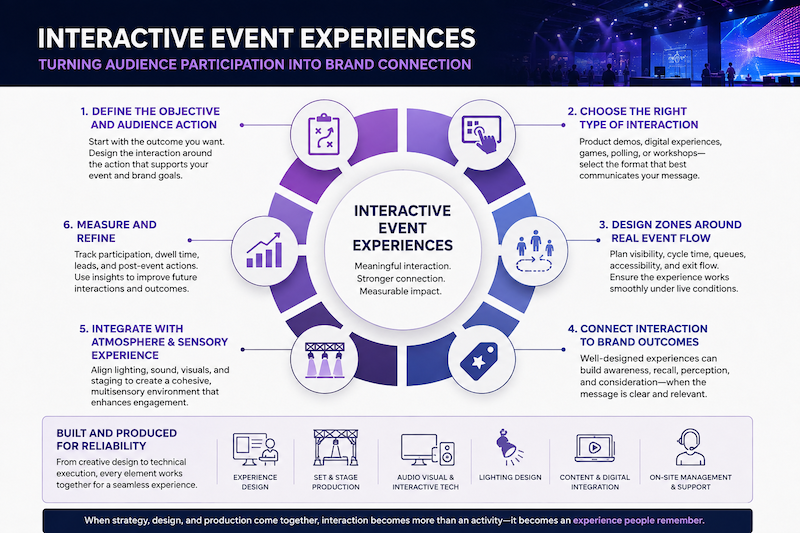 Interactive event experience design connects audience objectives, interaction formats, event flow, brand outcomes and technical production into one coordinated experience.
Start With the Audience Action, Not the Technology
Before selecting screens, games, or installations, define what you want attendees to do and understand.
 A strong event marketing strategy begins with clear behavioural goals. For example, you may want visitors to try a product, understand a feature, share feedback, or spend more time with the brand.
| Objective | Effective Interactive Approach | Key Consideration |
|---|---|---|
| Explain a product | Guided demo or hands-on trial | Can users understand value within seconds? |
| Encourage discovery | Touchscreen or interactive display | Is navigation intuitive without assistance? |
| Collect feedback | Live polling or digital input station | Is participation quick and frictionless? |
| Build engagement | Game, challenge or collaborative activity | Does it avoid blocking crowd movement? |
| Generate leads | Scan, sign-up or consultation interaction | Is the exchange clearly valuable to visitors? |
This is where interactive brand experiences become more powerful than passive displays; they connect action directly to meaning.
Types of Interactive Zones That Strengthen Brand Experience
Product-Focused Engagement Zones
For launches and exhibitions, product demonstration zones allow visitors to see and experience features in real time.
When appropriate, hands-on product trials help translate abstract claims into tangible understanding. For example, testing responsiveness, comparing materials, or interacting with a working prototype creates stronger recall than static visuals.
These experiences often improve comprehension and can positively influence purchase intent by reducing uncertainty.
Digital and Immersive Interaction
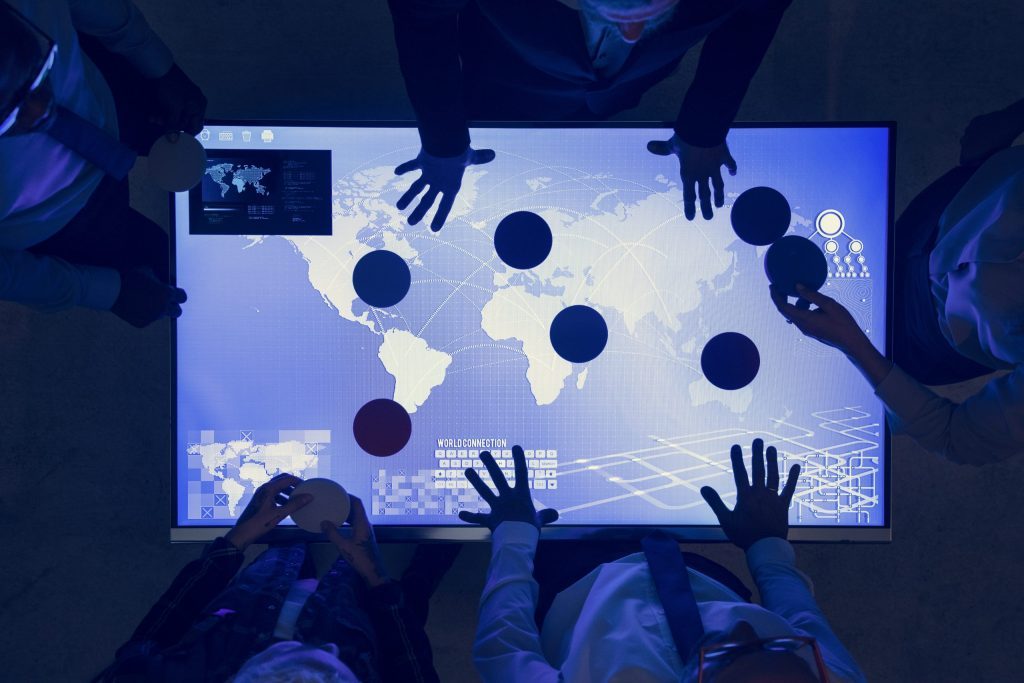
Interactive LED walls, AR-enabled product exploration, and live audience engagement systems can be incorporated through event experience design and production to connect digital interactions with the wider AV environment. Their lighting, visuals, sound and placement should also support the event atmosphere so the interaction feels integrated with the wider experience.
However, technology must always serve a purpose. A digital game or interface should reinforce the event message, not distract from it.
Read more about: How the Right Event Atmosphere Creates Immersive Experience and Elevates Brands
Physical and Social Engagement Activities
Not all hands-on event activities require screens or advanced systems. Workshops, sampling stations, live demonstrations, and collaborative installations can create equally strong engagement.
These formats often rely more on spatial planning, staffing, and flow management than on technology.
How To Design Interactive Zones Around Real Event Flow?
Interactive zones must work smoothly under live conditions, not just during rehearsals. Plan around how attendees approach, participate and move on.
Key questions include:
- How will visitors notice the zone?
- Can they understand the activity quickly?
- How long does each interaction take?
- Where can people wait without blocking traffic?
- Where do participants go afterwards?
Cycle time affects capacity. Longer interactions can quickly create queues, so high-demand zones may need shorter activities, additional stations or more waiting space.
Accessibility matters too. Use clear instructions, readable visuals, appropriate heights and enough room for both participants and staff.
For technology-driven zones, include a simple fallback or reset process to minimise disruption if a system goes offline.
How Participation Supports Brand and Commercial Outcomes?
Audience participation at events can create more opportunities for people to process information because they are doing something with the message rather than only receiving it. The strength of that effect still depends on relevance, execution and the attendee’s existing interest.
For a new brand, a highly visible activity may contribute to brand awareness. Consistent cues across the activity, environment and follow-up can support brand recall, while customised event experience design can help align those interactions with the wider brand idea.
A well-run hands-on product experience may also shape brand perception by showing how the product behaves in practice.
For products that benefit from demonstration, participation can reduce uncertainty by letting people see the process or try the feature themselves. That can support purchase consideration, but the event should not be treated as proof that every participant will buy.
Common Mistakes in Interactive Zone Design
1. Adding interaction without purpose
Engagement must support a clear objective, not just fill space.
2. Overcomplicating participation
If instructions are unclear, staff become the bottleneck and queues grow.
3. Ignoring operational reset time
Every interaction has a reset cycle—this must be included in planning capacity.
4. Separating creative and technical planning
AV, lighting, sensors, and content must be designed together to avoid live issues.
5. Designing only for participants
Observers and waiting audiences are part of the experience and should also be considered in layout and storytelling.
How DOREMi Builds Interactive Event Experiences?
DOREMi integrates event experience design and production with technical execution to ensure interactive zones function seamlessly within the full event environment. This includes audience journey planning, AV integration, lighting design, staging, and interactive technology deployment.
Through its brand activation production services, DOREMi develops engagement-driven environments where interaction is not an add-on but part of the overall event structure.
At events such as the Malaysia Tech Expo 2025, DOREMi implemented touch-sensitive LED walls, AR product exploration systems, and interactive content zones that combined digital engagement with physical exhibition design. These systems were supported by wider AV and production infrastructure to maintain reliable live operation.
Early planning is essential because interactive zones affect space allocation, power distribution, networking, staffing, and audience flow—all of which must be resolved before final build.
FAQs
What makes an interactive zone effective at events?
An effective interactive zone is easy to understand, quick to join, and directly connected to the event’s communication goal. It should encourage participation without creating confusion or congestion.
Do interactive zones always require digital technology?
No. Many successful engagement zones use physical interaction such as sampling, demonstrations, or workshops. Technology is only needed when it enhances clarity or scalability.
How do interactive zones improve brand experience?
They allow audiences to experience the brand directly, which increases emotional connection, improves recall, and strengthens understanding of product value.
How can crowd flow be managed in interactive areas?
By designing clear entry and exit points, controlling cycle time, duplicating high-demand stations, and ensuring waiting areas do not block movement paths.
Can DOREMi handle both design and technical production?
Yes. DOREMi manages both creative experience design and full technical production, ensuring interactive zones function reliably within the overall event environment. Speak to our event specialist to explore how your interactive concept can be developed into a practical event experience and production plan.
Conclusion
Interactive zones and hands-on engagement at events are most effective when they are designed with purpose, clarity, and operational realism.
When interaction is aligned with event objectives and supported by strong production planning, it transforms passive audiences into active participants who experience the brand directly.
Planning an event with interactive engagement zones? Speak to our event specialist to explore how DOREMi can design and produce immersive, high-impact brand experiences.