Key Takeaways
- A multisensory event coordinates sensory cues around a clear audience experience rather than treating them as separate effects.
- The right sensory mix depends on the event objective, audience, venue and key moments—not on using all five senses.
- Lighting, sound, visuals and interaction are most effective when they reinforce the same creative direction.
- Strong multisensory design uses contrast, pacing and restraint to maintain focus and audience comfort.
- Planning should begin with what attendees should feel, understand and do before deciding which technology to use.
Introduction
An attendee enters a product launch. Ambient lighting establishes the mood. Music builds anticipation. LED content directs attention towards the stage. At the reveal, sound, visuals and lighting change together before guests move closer to experience the product themselves.
None of these elements is unusual on its own. What makes the event multisensory is how they work together around the audience journey.
A multisensory event experience deliberately combines sensory cues to influence what attendees notice, feel and do at key moments.
What Actually Makes an Event Multisensory?
Having LED screens, speakers, lighting, décor and catering in the same venue does not automatically create a multisensory experience.
Effective experiential event design begins with the intended audience response, then selects the sensory inputs that help create it. Sight may establish focus. Sound can shape pace and anticipation. Touch can turn a product claim into something attendees can test directly.
In practical terms, multisensory design has three layers:
- Sensory input: what attendees see, hear, touch, smell or taste.
- Experience orchestration: how those elements are positioned, timed and combined.
- Audience response: what people notice, understand, feel or do.
This distinction matters during production. An LED sequence and lighting cue may both work well independently, but if they compete during a reveal, the audience may not know where to look.
How Do the Five Senses Work Together in Event Design?
Sight, sound, touch, smell and taste are best treated as design inputs rather than a checklist. Most events only need the senses that contribute meaningfully to the experience.
The framework below shows how sensory inputs, audience touchpoints and production planning work together to create one coordinated multisensory event experience.
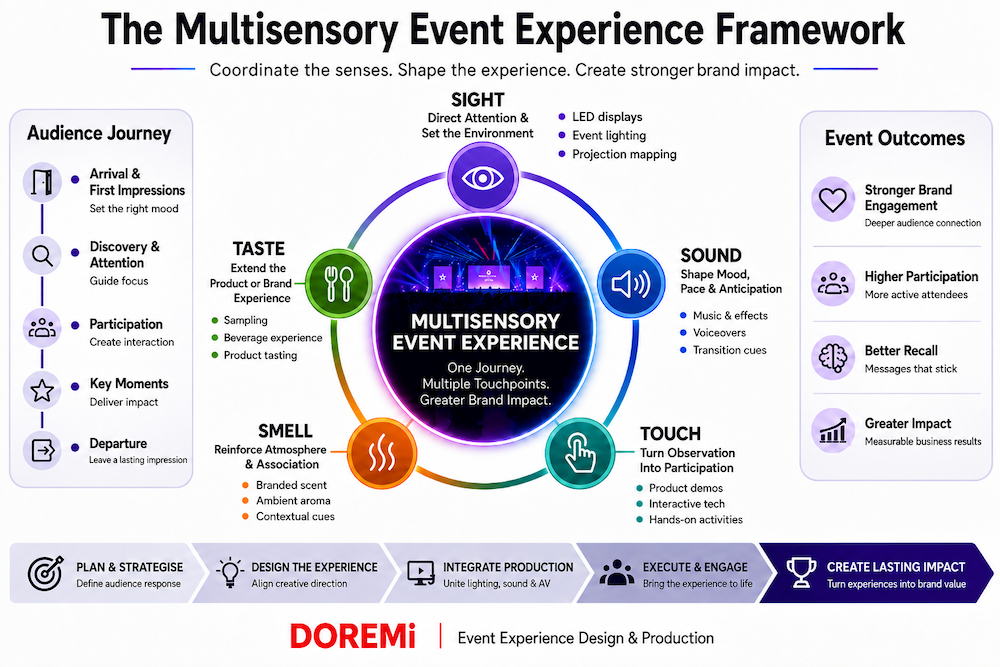 Multisensory Event Experience Framework: coordinating sensory cues, audience journey and production to create stronger event and brand outcomes.
How Sight Directs Attention and Establishes the Environment
Visual elements provide immediate cues about where attendees should look and what kind of environment they have entered.
LED screen displays, event lighting systems and projection mapping can establish atmosphere, highlight important areas and make programme changes easier to recognise.
Lighting may isolate a speaker, direct attention towards a product or shift the room into a reveal. LED and projection content can establish context before anyone speaks.
How Sound Shapes Mood, Pace and Anticipation
The auditory experience extends beyond making speech audible.
Music, effects, voiceovers and transition cues can change the energy of the room or signal that a key moment is approaching. During a product reveal, for example, an audio build can support the visual and lighting transition so the moment has a clear beginning and climax.
This depends on a professional sound system designed around the venue, audience size and programme. Volume alone cannot compensate for poor coverage or unclear speech.
How Touch Turns Observation Into Participation
Touch is particularly useful when audiences need to understand something by doing.
Product demonstrations, touchscreens, interactive installations and hands-on activities allow attendees to experience a claim rather than simply hear it.
For an activation or exhibition, the operational detail matters just as much as the creative idea. If one interaction takes several minutes, queues can quickly reduce participation. Sensory interaction therefore needs to account for throughput, instructions, staffing and surrounding audience flow.
For a deeper look at this approach, explore How Interactive Zones and Hands-On Engagement Amplify Brand Experiences at Events.
How Smell and Taste Add Context
Smell and taste are most useful when they have a natural relationship with the product, environment or campaign.
Food aromas may support an F&B activation. Sampling can turn a product story into a direct experience. A relevant scent may reinforce a particular environment.
These senses also require additional consideration. Allergies, sensitivities, venue rules, hygiene, serving logistics and scent intensity can affect whether the idea is practical.
Branded refreshments alone do not necessarily create meaningful multisensory engagement. The sensory element should contribute to the event concept.
 How Multiple Senses Create One Experience
The value comes from how individual cues connect.
A launch sequence might progress through:
Lighting transition → audio build → visual reveal → product interaction
Each element performs a different role, but together they create one clear audience moment.
This is also how the right event atmosphere can create a more immersive brand experience: lighting, sound, spatial design and content reinforce the same creative direction instead of competing for attention.
 How Does Multisensory Design Shape the Audience Journey?
Different stages of an event call for different levels of sensory intensity.
1. Set the Tone at Arrival
Entrance lighting, ambient sound, signage and spatial design establish expectations before the programme begins.
A restrained environment may suit a premium event. A more energetic entrance may prepare audiences for a launch or celebration.
2. Guide Attention During Discovery
Lighting, screens and displays help attendees identify important areas, products or activities.
This is particularly important at exhibitions where several experiences may compete for attention.
3. Make Participation Easy
Product trials, demonstrations and installations should be intuitive.
If guests need lengthy instructions before they can participate, the interaction creates friction. Clear entry points, short activity cycles and visible guidance help keep people moving.
4. Concentrate Impact Around Key Moments
Reserve stronger sensory stimulation for moments that deserve greater emphasis, such as product reveals, keynote entrances, performances or announcements.
Contrast gives those moments more impact than maintaining maximum intensity throughout the event.
5. Create a Deliberate Ending
Closing visuals, audio cues, takeaways or final interactions can reinforce the intended message as attendees leave.
The ending should feel connected to the journey rather than becoming an additional standalone effect.
How Can Multisensory Experiences Support the Brand?
Brands often need to communicate qualities that are difficult to express through logos alone: innovation, precision, luxury, energy or calm.
A technology launch may use dynamic content, contemporary sound and hands-on interaction to communicate innovation. A premium launch may rely on controlled lighting, refined staging and deliberate pacing.
The environment makes these qualities tangible.
The important factor is relevance. Spectacle may attract attention, but if attendees cannot connect the experience to the brand, the effect has done little to reinforce the intended association.
This is where customised event experience design becomes important. The sensory environment, audience journey and interactions should feel specific to the brand and event objective, helping support stronger brand perception and affinity over time.
Why Restraint Matters in Multisensory Design
Continuous stimulation makes it harder to establish hierarchy.
If every screen is moving, the lighting is constantly changing and the audio remains intense, the audience has fewer cues about what deserves attention.
A more deliberate progression might be:
Calm arrival → gradual build → high-impact moment → quieter interaction
Audience comfort also matters. Sound levels, flashing visuals, strong fragrances and crowded interaction areas can affect accessibility and the overall experience.
Strong multisensory design therefore includes quieter moments, clear focal points and appropriate sensory intensity.
How to Plan a Multisensory Event Experience
Step 1: Define the Intended Response
Decide what attendees should feel, understand, do and take away from the experience.
Step 2: Identify the Moments That Matter
Prioritise arrival, presentations, reveals, interaction points and departure rather than giving every programme segment the same level of treatment.
Step 3: Choose the Right Sensory Mix
Match the sensory approach to the event.
A conference may rely mainly on sight and sound with selected interaction. A product launch may benefit from sight, sound and touch. F&B activations can naturally incorporate smell and taste.
Step 4: Build One Production Plan
Event production management brings lighting, audio, LED content, projection, staging and show cues into one programme.
This is particularly important when one moment depends on several systems firing in sequence.
Step 5: Test the Audience Experience
Technical checks confirm that equipment works. Rehearsals should also confirm that the experience works.
Review:
- cue timing
- sightlines
- audio coverage
- screen visibility
- audience movement
- interaction throughput
- accessibility and comfort
- transitions between moments
The objective is to identify friction before attendees experience it.
How DOREMi Delivers Multisensory Event Experiences
DOREMi brings creative planning, technical production and on-site execution together to support multisensory event concepts.
From lighting and sound to LED displays, projection mapping, staging and show coordination, each element can be planned around the same audience journey.
This integrated approach is particularly important for moments where content, lighting, audio and live action need to happen in sequence. It also allows venue limitations, sightlines, audience movement and technical requirements to be considered before the event reaches site.
FAQs
Can a small event still use multisensory design?
Yes. Scale is less important than coordination. A smaller event can create a clear multisensory experience through well-planned lighting, audio, visuals and selected interaction without relying on complex technology.
How early should sensory elements be planned?
Ideally during concept development, before the venue layout and technical requirements are fixed. Early planning makes it easier to coordinate creative ideas with power, rigging, acoustics, audience flow and other venue constraints.
What accessibility considerations apply to multisensory events?
Consider sound levels, flashing or fast-moving visuals, fragrances, physical access, crowd density and how easily guests can understand interactive elements. Alternative ways to participate may also be useful where an experience relies heavily on one sense.
How can you measure the success of a multisensory experience?
Use measures linked to the event objective. These may include participation, dwell time, product interactions, leads, attendee feedback and post-event actions.
Can DOREMi combine lighting, sound, LED and projection into one event experience?
Yes. DOREMi’s event production capabilities cover AV, sound, LED displays, lighting, projection mapping and staging, allowing these systems to be planned around the wider programme rather than treated as separate technical requirements.
Can DOREMi help design the experience or only provide event equipment?
DOREMi supports event planning, technical coordination, equipment operation, stage management and on-site execution, allowing the experience and production requirements to be considered together.
Conclusion
A multisensory event is defined by how effectively its sensory elements support the audience journey.
Lighting, sound, visuals, interaction, smell and taste each have different roles. The strongest experiences select only what is useful, coordinate those elements around the moments that matter and leave enough contrast for audiences to recognise where their attention should go.
For organisers, this makes multisensory design a practical framework for creating events that feel considered from arrival through to the final cue.
Planning a multisensory event in Malaysia? Speak with our event specialist to discuss how your event concept can be translated into a coordinated creative and technical production plan.